
When production targets are missed, the usual response is predictable: buy another machine, add another shift, hire more operators, or expand the facility.
But what if your factory already has the capacity it needs?
Many manufacturers struggle not because every resource is overloaded, but because work does not flow efficiently through the system. Materials wait. Jobs queue. Machines are starved. Operators wait for approvals or materials. Work-in-progress builds up before one overloaded process while other resources remain underutilised.
The result? A factory can appear busy everywhere while producing far less than its potential.
Capacity Is Not the Same as Throughput
A production line may have enough theoretical machine hours and labour available to meet demand. Yet its actual output can remain low because effective capacity is being lost to waiting, downtime, changeovers, quality issues, poor scheduling and process constraints.
Discover Where Your Factory Is Losing Capacity
Download the FREE Operational Loss Diagnostic to identify hidden losses across capacity, changeovers, quality, maintenance, and planning—and uncover opportunities to improve productivity and profitability.
Imagine five processes with the capacity to produce 500 units per day. If one critical operation can only consistently process 300 units, the entire system is effectively limited to that level.
Increasing the capacity of the other four processes will not solve the problem. It may simply create more WIP inventory waiting in front of the constraint.
This is why manufacturers need to focus on manufacturing flow improvement, not just capacity expansion. Recent manufacturing guidance similarly highlights bottleneck analysis, WIP accumulation, cycle times and real-time production visibility as key indicators of the process that is actually limiting throughput.
The Hidden Cost of Poor Production Flow
Flow problems are often hidden behind familiar symptoms:
- Increasing production lead times
- Excess work-in-progress between operations
- Frequent expediting and rescheduling
- Operators or machines waiting for work
- Overtime without proportional output growth
- Missed delivery commitments
- High utilisation in one area and idle capacity elsewhere
These symptoms can lead management to conclude, “We need more capacity.”
But adding resources before identifying the real constraint can be an expensive mistake. A bottleneck may be caused by an unreliable machine, excessive changeover time, inspection delays, material shortages, unbalanced workloads or even internal approval rules. Improving a non-constraint process may increase local efficiency without increasing total factory output.
Find the Constraint Before Buying Capacity
The first step is to understand how work actually moves through the factory.
Current State Value Stream Mapping (VSM) can reveal where materials and information spend time. Compare process cycle times, waiting times, queue lengths, downtime, yield losses and available capacity across operations.
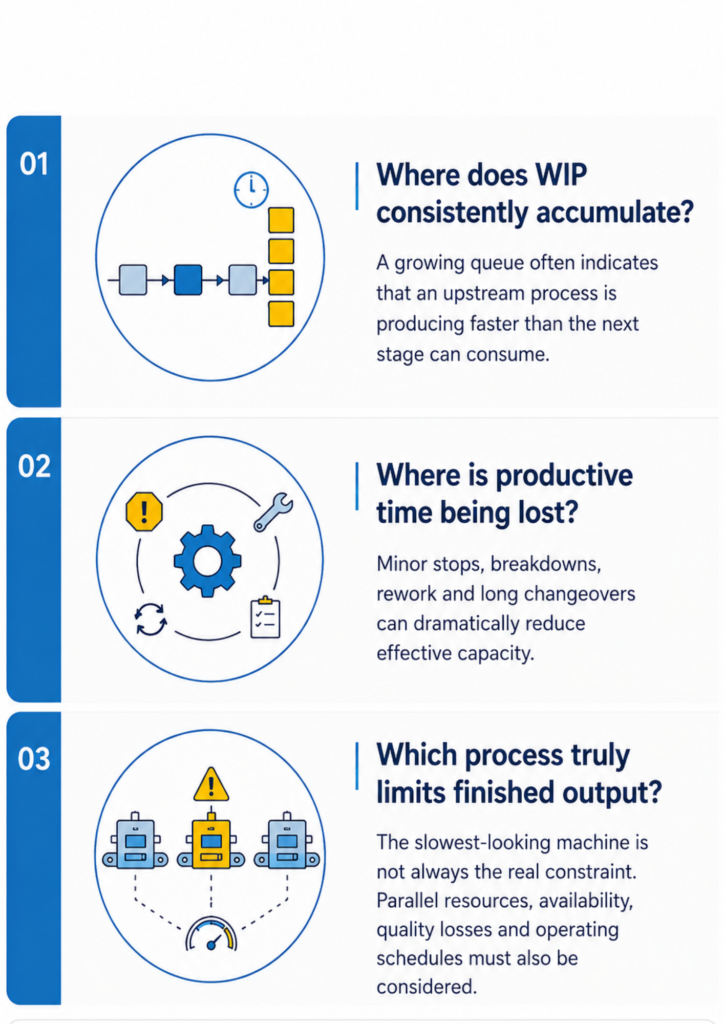
Look for three critical signals:
Improve Flow, Then Reassess Capacity
Once the constraint is identified, improvement should focus on protecting and strengthening the flow around it.
This may involve reducing changeover time, eliminating recurring downtime, balancing workloads, synchronising production schedules, improving material availability or removing unnecessary approvals and handoffs.
The goal is not to keep every machine busy every minute.
The goal is to keep value flowing to the customer.
As one constraint improves, another may emerge elsewhere. That is why flow improvement should be a continuous process of measuring, identifying, improving and reassessing.
Before approving the next CapEx request, ask a more important question:
Do we genuinely need more capacity; or are we simply losing the capacity we already have?
At Skil Global, we help organisations use Operational Excellence, Lean, Value Stream Mapping and data-driven process improvement to identify hidden constraints, improve throughput and unlock capacity from existing resources.
Want to discover where your production flow is breaking down? Connect with Skil Global for an OpEx assessment and start turning hidden capacity into measurable throughput.
Book a Call
FAQs
A flow problem occurs when materials, information or work do not move smoothly through production. Common causes include bottlenecks, waiting, downtime, excess WIP, poor scheduling and unbalanced workloads.
A factory can increase output by identifying and improving its production constraint, reducing downtime and changeovers, balancing workloads, improving scheduling and eliminating unnecessary waiting and rework.
Capacity is the potential amount a resource or factory can produce. Throughput is the actual rate at which finished products move through the entire system. A bottleneck can prevent available capacity from becoming actual output.
Manufacturers can identify bottlenecks by analysing WIP accumulation, cycle times, downtime, utilisation, queue lengths, quality losses and the effective capacity of each process stage.
If another process is the actual constraint, increasing capacity elsewhere will not improve total output. It may instead create additional WIP and operational complexity.