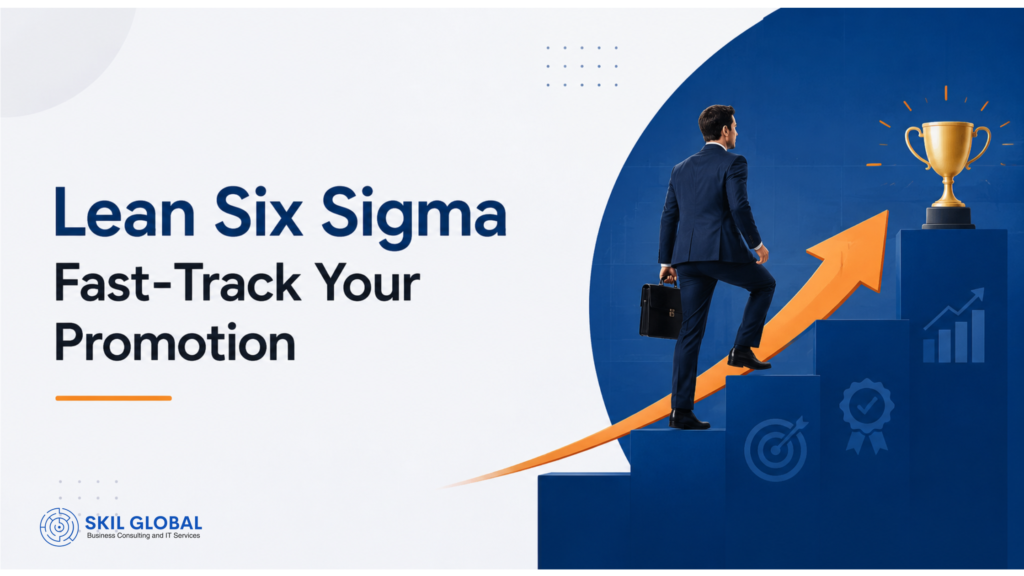
You work hard, meet your deadlines, and consistently deliver solid results. Yet when promotion season arrives, someone else gets tapped for the team lead or managerial role.
Sound familiar?
In today’s corporate environment, working hard is simply the baseline. Executives aren’t looking for employees who just do the job; they are actively hunting for professionals who can fix broken processes, eliminate waste, and drive measurable profitability.
From an employee’s perspective, getting certified in Lean Six Sigma is the single fastest way to transition from an operational worker to an indispensable leader. Here is how it reshapes your internal visibility and fast-tracks your career trajectory.
3 Ways Lean Six Sigma Transforms Your Career Trajectory
1. You Move from “Task Doer” to “Value Creator”
Most employees measure success by output: How many tickets did I close? How many reports did I complete? Leadership, however, measures success by business impact.
Lean Six Sigma equips you with the structured DMAIC (Define, Measure, Analyze, Improve, Control) methodology. Instead of complaining about process bottlenecks, you systematically identify root causes, streamline workflows, and quantify cost savings.
Real-World Impact: When you hand your manager a project report showing how your Green Belt initiative cut team operational cycle time by 22% and saved ₹5 Lakhs annually, promotion conversations stop being hypothetical.
2. You Speak the Language Executive Leadership Speaks
Decision-makers make promotion choices based on data, not gut feelings. Lean Six Sigma trains you to present facts using statistical analysis and root-cause matrices.
When you frame problems in terms of variance reduction, cycle-time efficiency, and financial ROI, senior executives stop viewing you as mid-level staff. You start contributing to high-stakes strategic initiatives, giving you direct exposure to top decision-makers long before your formal annual evaluation.
3. You Build Cross-Functional Leadership Authority
One of the biggest hurdles to earning a management role is proving you can lead people across departments.
Because Lean Six Sigma Green and Black Belt projects touch multiple organizational functions—from operations and supply chain to finance and HR—you naturally lead cross-functional teams to consensus. You gain cross-departmental influence, proving you are ready for broader managerial authority.
Career Evolution: Individual Contributor vs. Certified Process Leader
| Career Dimension | Individual Contributor | Certified Lean Six Sigma Leader |
| Focus | Task execution & completing routine assignments | Process optimization & enterprise value creation |
| Success Metrics | Activity output (tickets closed, hours logged) | Financial ROI, defect reduction, cycle-time speed |
| Leadership Scope | Department-bound tasks | Cross-functional project leadership |
| Executive Visibility | Confined to direct supervisor | High (presents data-driven solutions to leadership) |
Which Belt Level Should You Choose for Your Career Goals?
Choosing the right certification level depends on your current role and immediate career aspirations:
- Lean Six Sigma Green Belt: Ideal for aspiring team leads, senior analysts, and module leads who want to master practical DMAIC tools and lead focused, high-impact department projects.
- Lean Six Sigma Black Belt: Best suited for experienced managers and project leads targeting director-level roles, enterprise-wide transformations, and strategic decision-making responsibility.
Take Control of Your Career Path Today
Stop waiting for your hard work to speak for itself. Equip yourself with globally recognized continuous improvement credentials that compel leadership to notice you.
Ready to step into your next leadership role?
Master practical continuous-improvement frameworks with Skil Global’s Expert-Led Lean Six Sigma Certifications (Green & Black Belt).
- Certification: The certificate is accredited by CSSC, USA
- Practical Application: Work through real-world case studies with high business ROI.
- Career Support: Access lifetime guidance to accelerate your leadership trajectory.
Explore Skil Global LSS Certification Programs →
Frequently Asked Questions (FAQs)
While no certification guarantees a title change on its own, Lean Six Sigma provides the framework to deliver quantifiable cost savings and efficiency gains. Presenting these data-backed results to leadership builds an undeniable case for career advancement.
For mid-level professionals seeking team lead or manager roles, the Lean Six Sigma Green Belt is the ideal starting point. If you are already managing teams or aiming for senior executive roles, the Lean Six Sigma Black Belt provides advanced statistical leadership and organizational transformation skills.
Skil Global offers flexible learning paths, including virtual instructor-led classes (Weekends or Weekdays) and self-paced programs. Green Belt programs typically span 40 hours, while Black Belt programs require 80 hours of immersive, practical training.
Error: Contact form not found.