Most manufacturing plants do not struggle to identify problems. The real battle begins after the initial improvement project is completed.
Consider these familiar scenarios:
- A packaging line improves OEE for three months, only to slip back to old performance levels.
- A pharma plant reduces batch failures temporarily, but deviations slowly creep back.
- A changeover reduction project shows massive early gains, but six months later the line is back in firefighting mode.
This is one of the greatest operational excellence challenges across FMCG and pharmaceutical manufacturing: sustaining improvements after the project teams walk away.
In many factories, initiatives create short-term momentum but fail to embed into the daily operating system. The reason is simple: Improvement is often treated as an event instead of a management discipline.
The Reality of Operational Drift: According to operational diagnostics conducted across manufacturing environments, 15–35% of productive capacity is typically lost due to hidden operational inefficiencies. Most of these losses return because sustainment mechanisms are weak or absent altogether.
Why Operational Improvements Fade
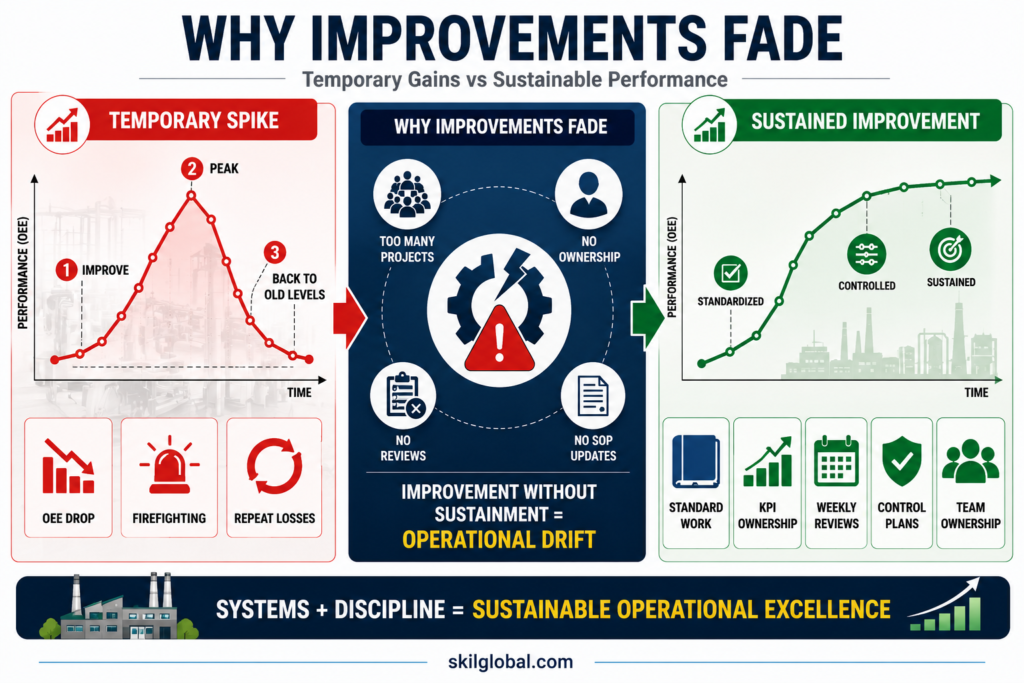
When operational improvement programmes fail, they usually do so for highly predictable reasons:
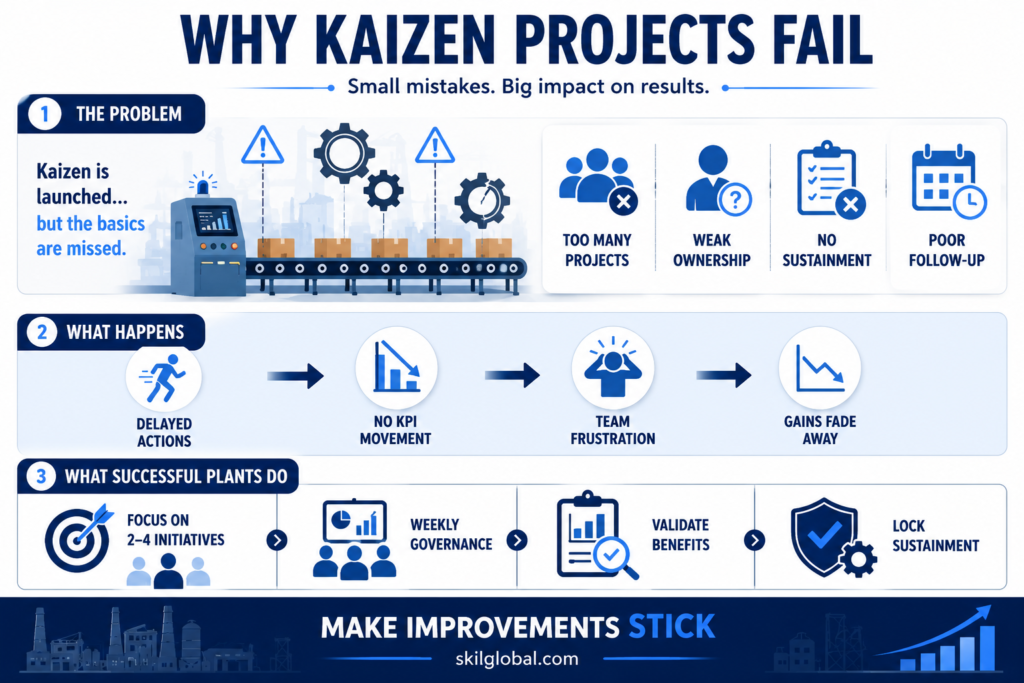
- Diluted Focus: Too many competing initiatives launched simultaneously.
- No Long-Term Custody: Weak ownership on the shopfloor post-implementation.
- Lack of Rhythm: No weekly management or governance rhythm to track variances.
- Outdated Documentation: Standard operating procedures (SOPs) are left unrevised.
- Invisible Metrics: A distinct lack of daily KPI accountability and automated control plans.
These structural gaps create temporary performance spikes rather than permanent baseline shifts.
FMCG vs. Pharmaceutical Operations
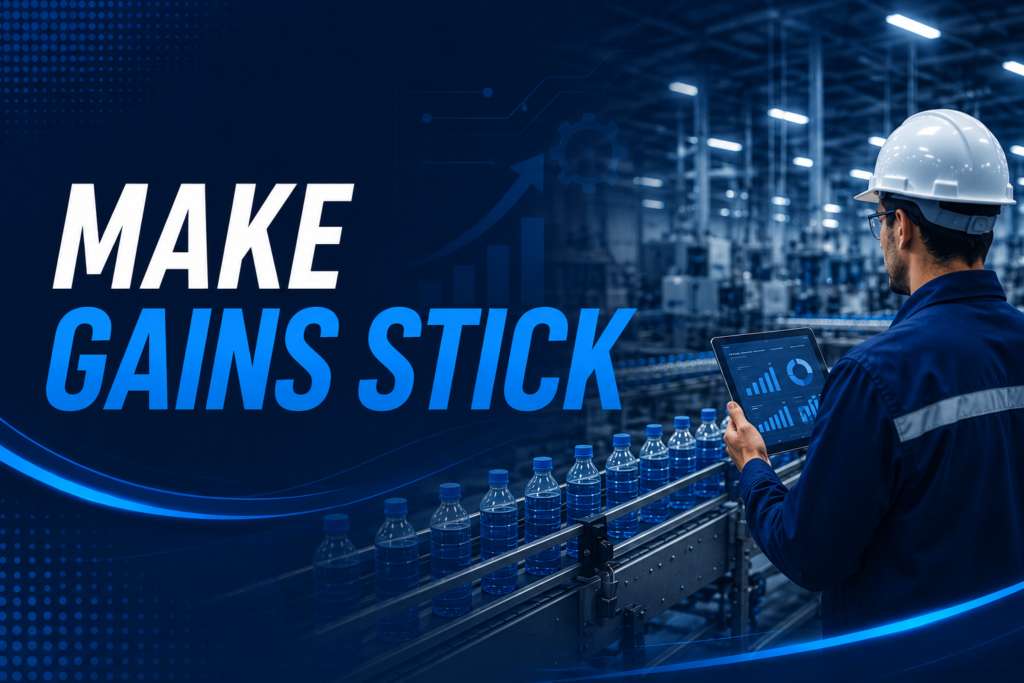
- In FMCG plants, this shows up glaringly in packaging operations. Teams may successfully reduce minor stops during a focused Kaizen event. But if operators aren’t trained on the revised standard work—or if shift-level reviews taper off—performance inevitably deteriorates.
- In pharmaceutical manufacturing, the stakes are even higher. Process consistency directly impacts compliance and batch quality. Improvements in reject reduction or deviation management vanish the moment documentation practices, reaction plans, and review mechanisms stop being treated as a routine operating requirement.
Case Study: Structured Sustainment in Action
One of our recent improvement programmes focused on reducing batch failures within a complex biosimilars manufacturing environment. The plant faced recurring process deviations, quality losses, and inconsistent execution between shifts.
Instead of treating the issue as a one-time quality investigation, the initiative focused heavily on structured execution and long-term sustainment:
- Shopfloor Validation: Root causes were mapped and validated directly at the machine level, not in a boardroom.
- Dynamic SOPs: Standard operating procedures were completely revised and simplified.
- Active Ownership: True KPI ownership was assigned to shift supervisors, not just the plant manager.
- Governance Loops: Weekly review mechanisms were hardcoded into the plant’s governance calendar.
- Capability Transfer: Cross-functional teams were thoroughly upskilled on the new process controls.
The Result: The plant achieved a highly stable operating baseline supported by genuine operational discipline, eliminating the historical “firefighting” cycle. This reflects a vital lesson across both FMCG and pharma sectors: sustainable improvement requires robust management systems, not just technical fixes.
The 5 Core Pillars of Sustainable Operational Excellence
The most effective operational excellence programmes focus on sustainment from Day 1—not as an afterthought. Robust sustainment systems rely on five foundational pillars:
1. Standardised Work
If improvements are not converted into documented, repeatable standard work, teams naturally drift back to old habits. Operators, supervisors, QA, and maintenance teams must clearly understand the modified method and its associated process controls.
2. Strict KPI Ownership
Every critical metric needs a visible custodian. Whether the KPI is changeover time, minor stoppages, reject percentages, or overall throughput, a dedicated owner must review performance daily and trigger corrective action the moment a deviation appears.
3. Rigorous Weekly Governance
Many projects die because reviews become irregular once the initial enthusiasm fades. A disciplined weekly governance rhythm forces teams to track KPI movement, close pending actions, escalate blockers, and maintain execution momentum.
4. Control & Reaction Plans
Sustainment requires highly visible controls on the shopfloor. Leading plants clearly define acceptable operating limits, escalation triggers, and immediate corrective actions. Without pre-defined reaction plans, teams only notice problems after significant losses have already reoccurred.
5. Absolute Capability Transfer
Sustainable improvement cannot depend on external consultants or a single internal champion. The shopfloor team must completely own the new process. Continuous coaching, practical training, and layered accountability are essential for long-term operational stability.
Moving from “Projects” to Operating Discipline
High-performing plants do not treat improvement as isolated Kaizen activity. Instead, they consciously build structured governance, financial validation, leadership visibility, and continuous accountability directly into their operational DNA.
Our 90–120 Day Improvement Programme is specifically designed around this philosophy—delivering rapid, measurable results while simultaneously embedding the systems required to prevent performance from slipping backward.
If you are looking to execute operational improvements that actually stick, our A2 Improvement Programme Framework outlines how manufacturing organisations implement and sustain measurable gains across productivity, quality, and asset downtime.
Inside the guide:
- Our integrated Kaizen / DMAIC execution approach
- The exact weekly governance structures required for leadership visibility
- Practical benefit validation methods to prove financial ROI
- Sustainment controls, standardised work templates, and KPI ownership systems
Ready to Lock In Your Operational Gains?
If your plant is struggling with performance improvements that fade away within weeks of deployment, let’s build a resilient sustainment roadmap together.
[Book a 45-Minute Improvement Programme Scoping Call] with the SKIL Global team today to identify where your operational gains are slipping, prioritize your highest-value initiatives, and establish a framework to achieve sustained, measurable benefits within the next 90–120 days.
form