Many manufacturing organizations invest significant time, resources, and leadership attention into operational excellence initiatives. Improvement projects are launched, teams participate in workshops, KPIs improve, and early results look promising.
Yet six months later, many plants find themselves facing the exact same problems they thought they had solved. OEE slips back to previous levels. Changeover times increase again. Downtime reappears. Quality losses creep back into operations. The problem is not usually the improvement initiative itself. The problem is that benefits are rarely managed with the same discipline used to deliver them.
The Hidden Problem: Improvements Are Not Sustained
Most manufacturing transformation programs focus heavily on identifying opportunities and implementing solutions. Far less attention is given to ensuring that the gains become part of normal operations. As a result, organizations experience what many leaders call the “improvement spike”—a temporary performance increase followed by a gradual, painful decline back to the baseline.
Common Symptoms of an Unprotected Project:
- KPI improvements that fade within 90 days of project closure.
- Standard Operating Procedures (SOPs) not being followed consistently by the next shift.
- Frontline teams quietly reverting to old ways of working.
- Financial benefits not being validated or tracked by the finance team.
- Leadership losing visibility the moment the project team disbands.
- Improvement projects being viewed as one-time events rather than operating system changes.
This challenge is particularly common in FMCG and pharmaceutical manufacturing environments where operational complexity is high and performance depends on consistent, disciplined execution across multiple shifts.
Turn Improvement Plans into Measurable Results
Get our FREE 90-Day Improvement Project Execution Playbook to learn a practical framework for planning, executing, and sustaining operational improvements.
Why Manufacturing Improvements Fail to Stick
Several root causes repeatedly appear across plants, regardless of the sector:
1. Lack of Clear KPI Ownership
Improvement projects often deliver impressive KPI jumps, but ownership becomes murky once the project team or consultants leave. Without defined, individual accountability on the shop floor, performance gradually drifts back toward historical levels.
2. Weak Governance Processes
Many organizations conduct intensive project reviews during implementation but stop formal reviews after closure. Without structured governance, emerging operational issues remain invisible until significant performance deterioration occurs.
3. Benefits Are Not Validated against the P&L
A common mistake is declaring success based on activity completion (e.g., “We held the Kaizen event!”) rather than measurable business outcomes. True benefits realization requires validation against agreed baselines and financial impact calculations. Without this, operational gains look good on paper but fail to show up on the plant’s P&L statement.
4. Control Plans Are Missing or Treated as Paperwork
Projects frequently improve processes without implementing mechanisms to sustain them. Control plans, reaction plans, Layered Process Audits (LPAs), and standard work updates are often treated as administrative checkboxes rather than critical business controls.
5. Leadership Attention Moves Elsewhere
Once initial targets are achieved, leadership naturally shifts focus to the next fire or new corporate priorities. Unfortunately, what leadership stops reviewing, the organization stops improving.
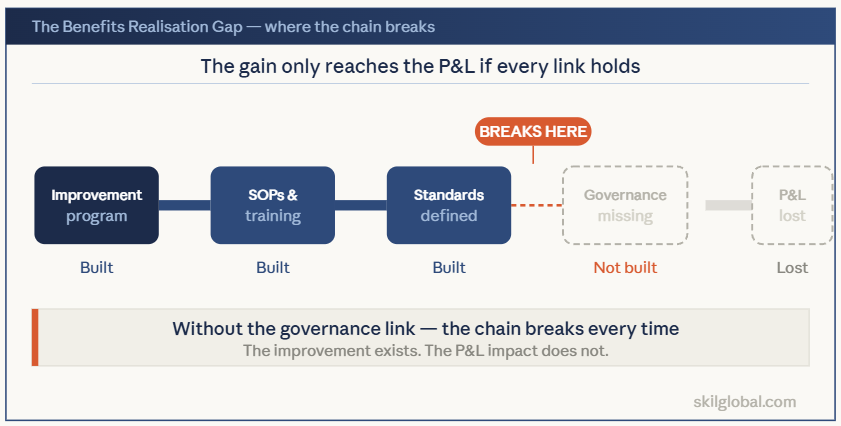
Real-World Examples: FMCG vs. Pharmaceutical
FMCG Packaging Operations
A beverage manufacturer successfully reduced changeover times through a SMED (Single-Minute Exchange of Die) initiative. During the first three months, average changeover duration improved by 35%. However, six months later, performance had completely regressed. An audit revealed that:
- New operators had not been trained on the updated sequence.
- Changeover toolkits and checklists were no longer being used.
- Weekly performance reviews had stopped.
- Supervisors were measuring total output but completely ignoring changeover adherence.
The technical solution was perfect. The sustainment system was entirely missing.
Pharmaceutical Manufacturing
A multinational pharmaceutical site launched a structured root-cause elimination initiative to reduce batch deviations and improve First Pass Yield (FPY) on a critical formulation line. Initial results exceeded expectations, driving down deviations by 40%.
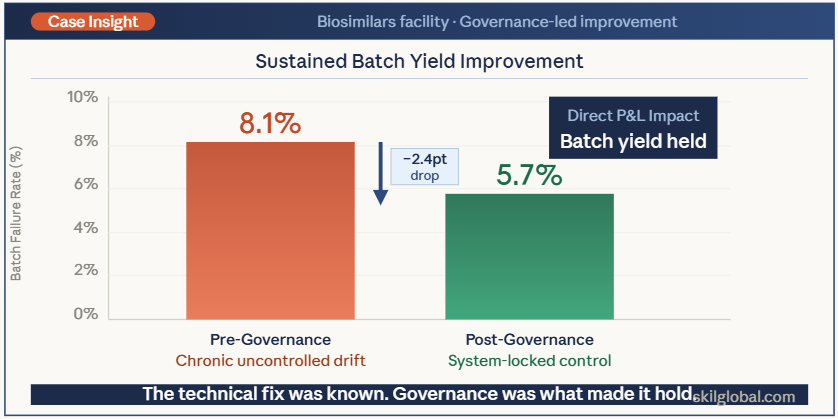
However, within twelve months, deviation rates began creeping back to historical levels, triggering a cascade of costly operational and regulatory bottlenecks. A retrospective investigation revealed:
- Repetitive CAPA Failures: While corrective actions were implemented during the project, they were never formally verified for long-term effectiveness. The site was treating symptoms, leading to reopened CAPAs.
- Audit Inconsistency: Periodic process audits dropped off the schedule as team priorities shifted, leaving operational drift completely unnoticed.
- Regulatory Vulnerability: Because the improvements were not institutionalized, the recurring deviations began raising red flags for upcoming regulatory inspections (such as FDA or EU Annex 1 audits).
- Reporting vs. Governance: Weekly KPI meetings had degenerated into passive data-reporting sessions rather than active governance reviews with clear escalation triggers.
⚠️ The Pharma Reality: Regulatory bodies don’t just audit your processes; they audit your ability to sustain corrective actions. Repetitive deviations are an immediate red flag for inspectors.
Project vs. Sustainment: The 12-Month Outlook
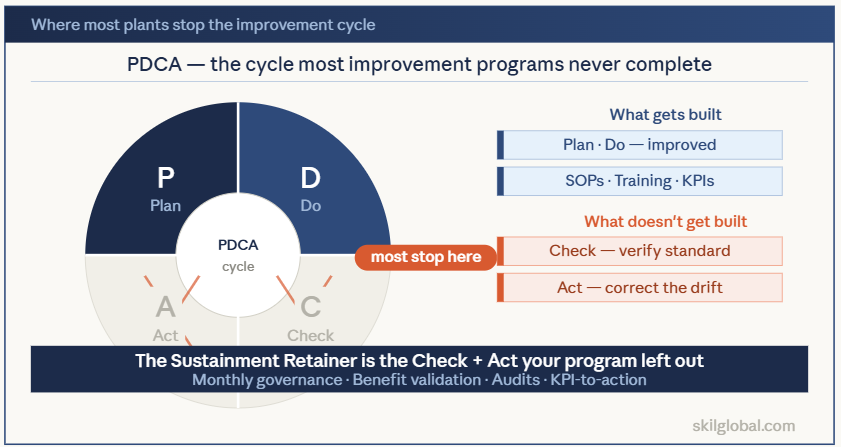
— the sustainment layer — rarely do.
To protect your investments, it is critical to look at how a plant behaves with and without a structured sustainment system.
| Phase | Standard “Project Only” Approach | Our Sustainment Retainer Approach |
|---|---|---|
| Months 0-3 (Implementation) | Performance spikes (+35% OEE / Yield). | Performance spikes (+35% OEE / Yield). |
| Month 6 (Post-Closure) | Teams revert; checklists abandoned; gains slip by 50%. | Layered audits occur; deviation triggers catch process drift early. |
| Month 12+ (Long Term) | Back to baseline. Initial investment completely wasted. | New baseline locked in. Financial ROI verified by Finance. |
The Solution: Governance, Audits, and KPI Discipline
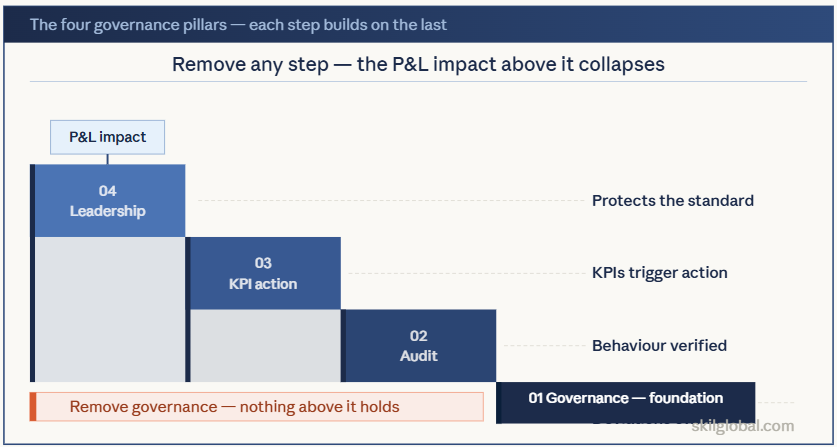
Leading manufacturing organizations recognize that implementation creates improvement, but governance protects it. Sustained performance requires a structured, independent operating system.
Monthly Governance Reviews
Governance reviews must happen away from daily fire-fighting and focus specifically on:
- Long-term KPI performance trends (not just yesterday’s numbers).
- Realized financial benefit status vs. the original business case.
- Action closure tracking and escalation management.
- Emerging operational risks before they cause an OEE crash.
KPI Management Systems
Effective sustainment requires ongoing monitoring of critical, interrelated shop-floor indicators:
- Overall Equipment Effectiveness (OEE) and Availability.
- Throughput and line speed vs. design capacity.
- Changeover performance (SMED adherence).
- First Pass Yield, batch rejection rates, and scrap/waste levels.
Rigorous Benefits Validation
Every improvement initiative must include a defined baseline, an agreed-upon financial calculation methodology, and formal finance sign-off. Benefits should never be assumed; they must be auditable.
Layered Process Audits (LPAs)
Periodic audits verify whether improvements remain embedded in day-to-day operations. Audits shift sustainment from a hopeful assumption to an auditable reality by checking standard work compliance, tool availability, and frontline training effectiveness.
The Leadership Role in Sustainment
Many leaders believe improvement projects fail because teams lack capability. In reality, improvements fade because leadership governance fades.
Sustainment is ultimately a leadership process, not a project management process. Effective leaders do not manage every micro-activity; instead, they create and respect the operating system that protects performance. They demand evidence-based validation, hold teams accountable to standard work, and actively participate in governance reviews. Benefits Realization Is the True Measure of Success
An improvement initiative should not be judged by the number of workshops completed, action items closed, or beautiful presentations delivered. It should be judged by one question:
Are the benefits still fully visible 12 months later?
Organizations that excel at operational excellence understand that implementation is only half the journey. The real value comes from protecting gains, validating benefits, and creating systems that sustain performance year after year.
Book a 30-Minute Sustainment Retainer Scoping Call
Have your operational excellence initiatives delivered results that are now at risk of slipping back? Our Sustainment Retainer helps FMCG and pharmaceutical manufacturers lock in their improvement gains. Book a 30-minute Sustainment Retainer Scoping Call to assess whether your current improvement gains are truly protected and sustainable.
Book a Call
Frequently Asked Questions
Benefits realization is the structured process of validating, tracking, and sustaining measurable business improvements resulting from operational excellence initiatives. It ensures that changes deliver lasting financial and operational value to the bottom line.
Improvements typically fade due to weak post-project governance, lack of clear KPI ownership on the shop floor, insufficient process audits, poor control plan adherence, and leadership attention shifting to new priorities.
A sustainment retainer provides ongoing, external governance, KPI reviews, benefit validation, operational audits, and leadership support. It acts as an insurance policy for your continuous improvement investments, preventing performance regression after project closure.
A sustainment retainer provides ongoing, external governance, KPI reviews, benefit validation, operational audits, and leadership support. It acts as an insurance policy for your continuous improvement investments, preventing performance regression after project closure.
Typical metrics include OEE, throughput, unplanned downtime, changeover duration, First Pass Yield, batch rejection rates, and material waste/scrap levels.
An improvement project focuses on delivering change and hitting an initial target. A sustainment retainer focuses entirely on protecting those gains, validating the financial return, maintaining governance, and preventing performance drift over the long term.