Walk through any modern fast-moving consumer goods (FMCG) or pharmaceutical plant today, and you will see no shortage of dashboards. Screen metrics flash on walls, smart devices track equipment in real time, and data is more abundant than ever.
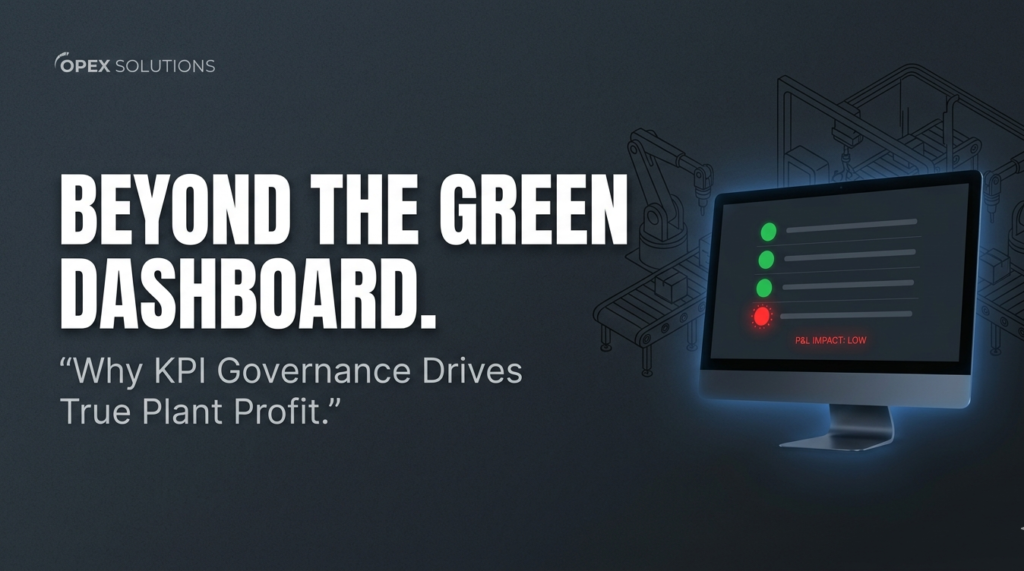
Yet, many site leaders face a confusing reality: their operational dashboards show a sea of green, but the plant’s commercial and output numbers are still flashing red.
When lines miss delivery targets or conversion costs spike, the immediate reaction is to generate more data, build more dashboards, or re-engineer the metrics. But the problem on modern production floors is rarely a lack of tracking. The problem is a lack of KPI Governance. Without strict governance, metrics become isolated vanity projects, losing their connection to actual business impact. This is why building a disciplined, audited metric system is the defining characteristic of elite manufacturing facilities.
The Operational Problem: “Metric Obesity” and Data Silos
Many plants suffer from what can be termed metric obesity—tracking hundreds of data points simply because modern enterprise and IoT tools make it easy to do so. When everything is prioritized, nothing is prioritized.
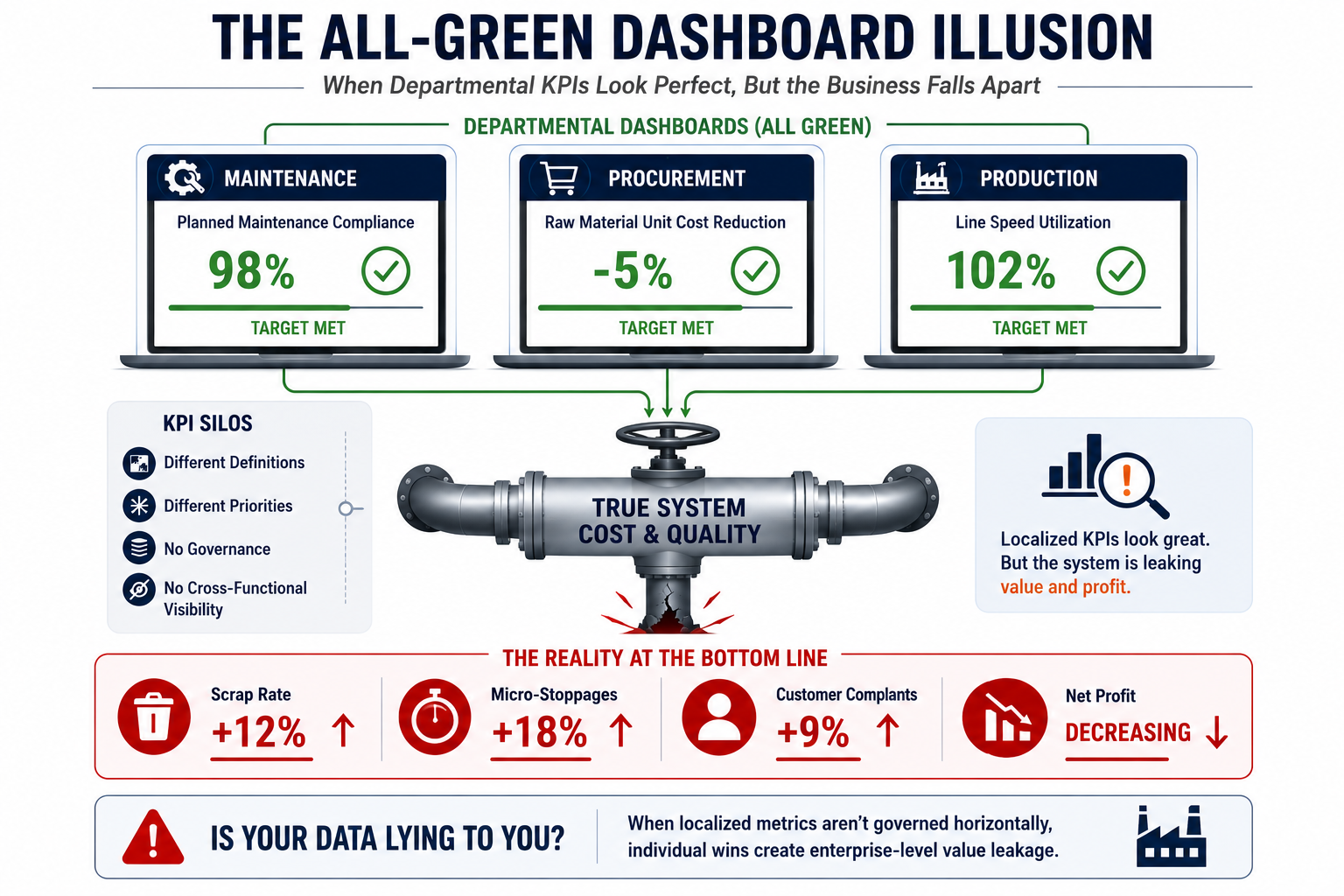
This over-tracking creates a highly fragmented operational reality:
- The Silhouette of Success: Individual departments optimize their own siloed targets. Maintenance hits its Planned Maintenance Percentage (PMP), Procurement reduces raw material costs, and Production maximizes line speed.
- The Hidden Loss: Despite these isolated “wins,” overall site performance lags. Raw material switches cause micro-stops, while high-speed runs result in increased scrap rates and quality reworks down the line.
- The Escalation Gap: Plant teams lose precious hours debating data validity rather than solving the systemic abnormalities causing the issues.
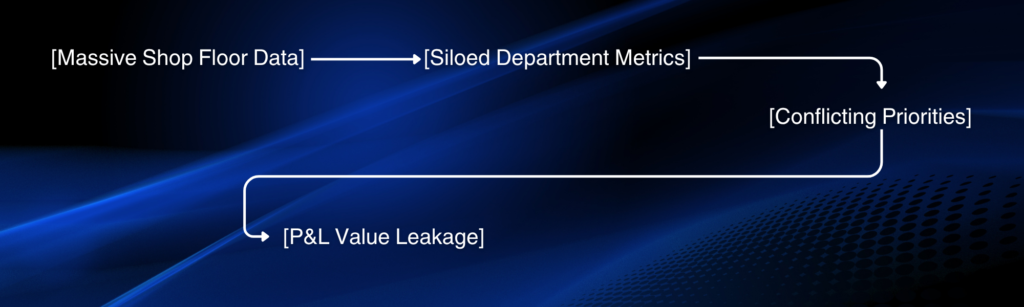
Why Metric-Driven Improvements Are Not Sustained
It is highly common for a plant to experience a major performance lift during an operational excellence drive, only to watch those metrics slowly degrade a few quarters later. This sustainment gap occurs due to specific operational breakdowns:
Turn Improvement Plans into Measurable Results
Get our FREE 90-Day Improvement Project Execution Playbook to learn a practical framework for planning, executing, and sustaining operational improvements.
1. Lack of Standardized Metric Definitions
If three different shift supervisors calculate Overall Equipment Effectiveness (OEE) or Downtime Rate differently—manually adjusting for “excused” setup delays or raw material shortages—the data baseline loses integrity. Without absolute metric standardization, true performance drifts.
2. No Formal Escalation Discipline
A metric is only as valuable as the immediate action it triggers. In many plants, when a tier-1 metric goes red on the floor, there is no structured response. It is simply noted during an end-of-shift review when it is already too late to salvage the lost throughput.
3. Missing Audit Guardrails
Most organizations audit compliance during a system roll-out but fail to audit the data entry and decision loops long-term. If operators realize leadership is no longer verifying log precision or auditing compliance with standard work, data entries become casual, and baseline performance regresses.
Sector-Specific Realities: FMCG vs. Pharmaceutical Plants
FMCG: The High-Speed Volume Illusion
Consider a high-volume cosmetics or food packaging facility tracking standard line throughput. To hit a aggressive shifts-volume target, operators run an automated cartoner slightly past its designated parameters. The shift report shows a massive win.
However, the over-speed run introduces micro-stoppages and subtle product damage that forces a massive surge in the scrap rate. Because throughput was viewed in a silo separate from a strict Cost Per Unit governance loop, the local volume win directly eroded the plant’s overall manufacturing margin.
Pharma: The Localized Cycle Time Trap
In a sterile pharmaceutical formulation facility, an engineering project team successfully optimizes a filling line, dropping the batch cycle time by 15%. The team is rewarded, and the project dashboard turns green.
But because the site’s true constraint is the QA/QC batch release process and deviation investigation cycle, the accelerated production simply creates a bottleneck of Work-in-Progress (WIP) inventory. Capital remains trapped on the floor, lead times remain flat, and the localized operational win fails to change the commercial outcome.
The Solution: Designing a Robust KPI Governance Framework
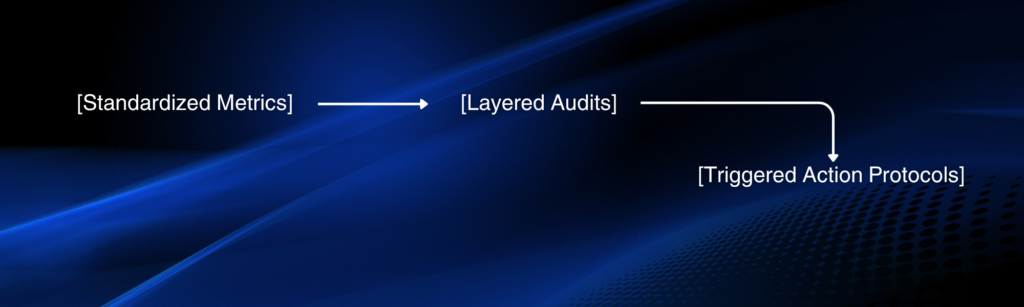
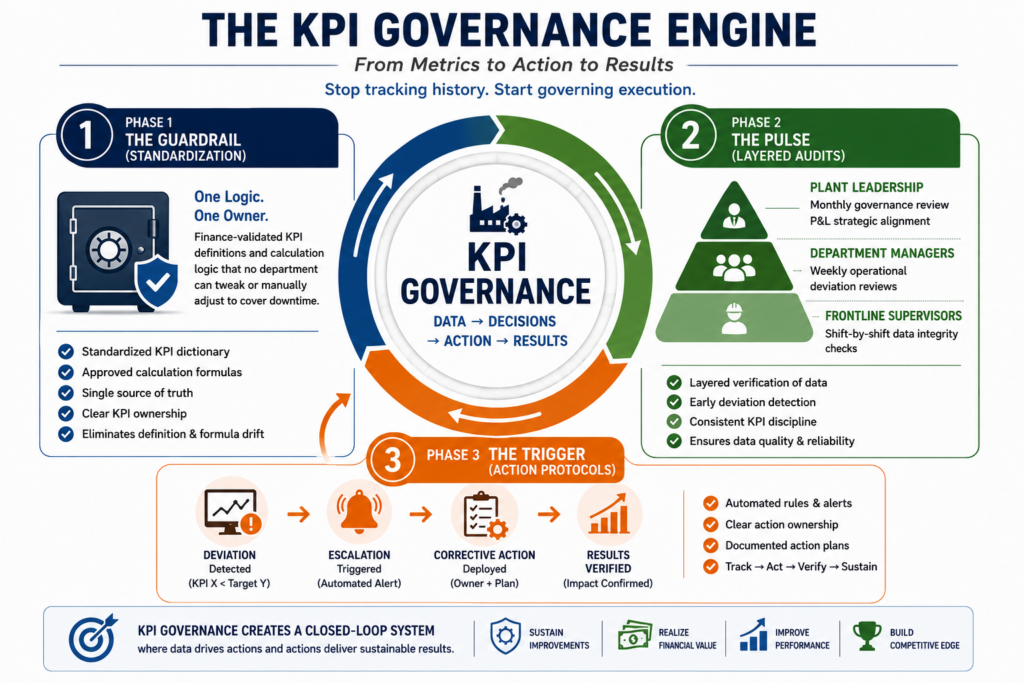
To transform metrics from passive historical records into dynamic operational levers, manufacturing leaders must install a comprehensive KPI Governance system structured around three pillars:
1. Explicit Data Owners & Rigid Standard Definitions
Every core plant metric must have a singular, cross-functional owner and an unalterable math logic signed off by Finance. The metric must measure system health, matching leading indicators (e.g., First Pass Yield) directly with trailing financial indicators (e.g., Cost Per Unit).
2. Layered Process Audits (LPAs) for Metric Veracity
Do not simply audit the product; audit the data habits on the floor. Shift supervisors must audit logging integrity daily, plant managers must audit the operational response paths weekly, and the executive team must audit alignment with corporate targets monthly.
3. Action-Oriented Control Cycles (Triggered Responses)
A governed KPI layout operates on hard logic: When KPI ‘X’ drops below Target ‘Y’ for more than ‘Z’ minutes, Action ‘A’ must execute automatically. If an asset hits an unacceptable Mean Time to Repair (MTTR), it should automatically trigger an engineering review, eliminating delayed reactions or manual communication gaps.
Driving True Operational Discipline
True operational excellence is built by leaders who recognize that maintaining a standard requires as much focus, discipline, and rigor as solving a sudden crisis.
Plant leadership must move away from simply reviewing historical performance decks. Instead, they must actively audit the management system itself. Leaders must demonstrate a strict intolerance for unaligned metrics, ambiguous data, and undocumented adjustments. When the plant head demonstrates that data integrity and standard operating adherence are non-negotiable, the entire culture adjusts to match that standard.
Secure Your Operating Baseline: Let’s Build a Resilient Governance Architecture
Tracking data is simple; enforcing the operational discipline to monetize that data is the real challenge. Our Sustainment Retainer is uniquely designed for FMCG and pharmaceutical operations looking to eliminate value leakage, align shop-floor actions with the P&L statement, and build clear accountability structures.
Book a Call
Frequently Asked Questions
KPI Governance is the structured framework that defines exactly how operational metrics are calculated, who owns them, how they link to financial outcomes, and the specific actions triggered when a metric falls out of compliance.
By mapping and governing metrics horizontally across the value stream, rather than vertically within individual departments. This ensures local efficiency targets (like running a line faster) do not accidentally increase waste, scrap, or inventory costs elsewhere.
High-performing sites utilize a tiered cadence: frontline supervisors execute brief checks every shift, department managers audit weekly, and plant leadership performs systemic governance reviews monthly.