Manufacturing leaders rarely struggle to find improvement opportunities. Walk through almost any FMCG or pharmaceutical plant and the leakage is visible: changeovers dragging past the target window, minor stops chipping away at asset utilization, and quality variations driving costly rework.
To combat this, operations teams invest heavily in Lean, Six Sigma, TPM, and digital transformation. Lean metrics move in the right direction, champions are certified, and workshops are celebrated. Yet, a few months later, the same executive frustration creeps back in.
The gains have quietly evaporated. Performance has drifted back to historical baselines, and teams find themselves troubleshooting the exact same problems. The issue isn’t a lack of improvement activity—it’s a lack of structural sustainment. This is where a Benefits Realization Office (BRO) becomes critical. It serves as the financial and governance anchor that ensures operational spikes become permanent baseline shifts.
Turn Improvement Plans into Measurable Results
Get our FREE 90-Day Improvement Project Execution Playbook to learn a practical framework for planning, executing, and sustaining operational improvements.
The Hidden Cost of “Ghost Savings”
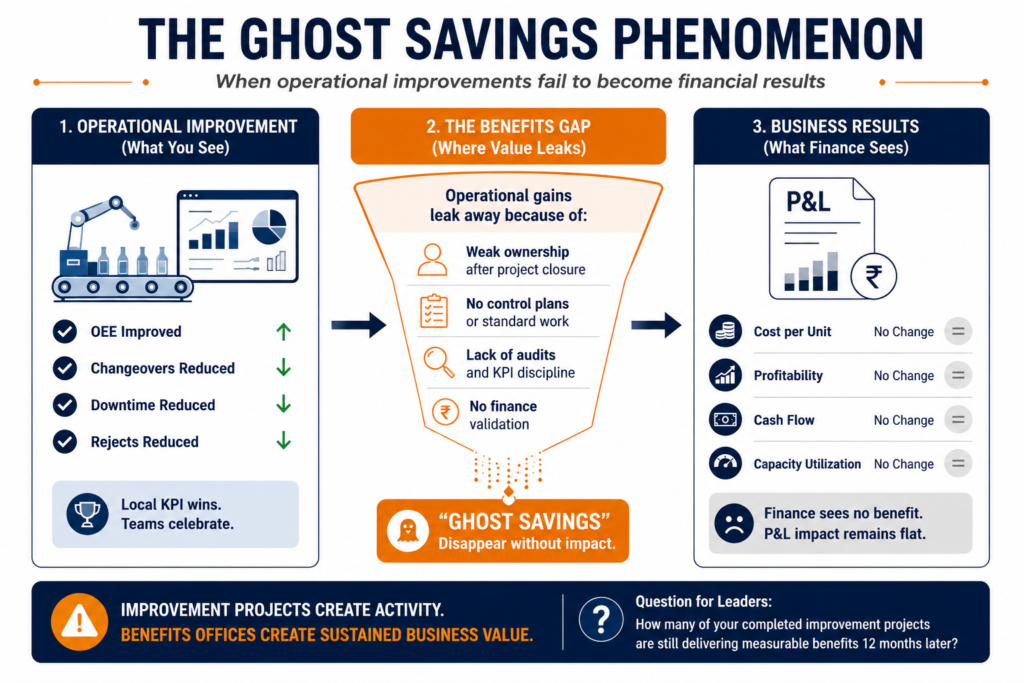
Many manufacturing organizations unknowingly suffer from operational value leakage. This occurs when an initiative delivers a short-term operational spike but fails to translate into hard business impact on the P&L statement.
On paper, a project that reduces changeover time by 20% or boosts OEE by 4% is a success. But if that capacity isn’t structurally captured, the organization never realizes the cash value of the effort. Without a dedicated governance mechanism to protect these gains, continuous improvement risks becoming continuous rework.
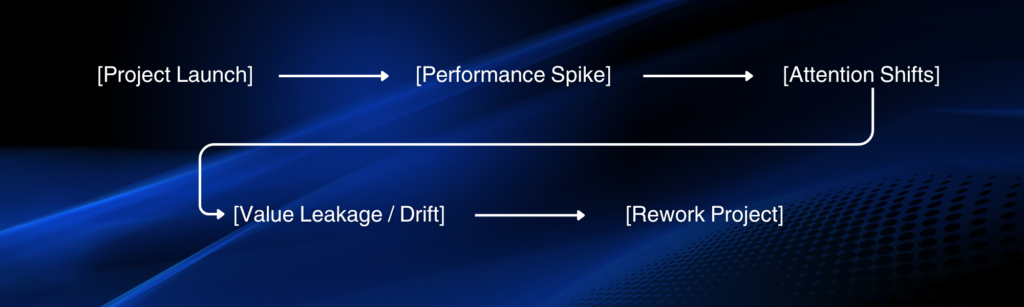
Why Manufacturing Gains Evaporate
When improvements fail, leadership often assumes the technical solution or engineering was flawed. In reality, the technical solution is rarely the failure point. The breakdown is structural:
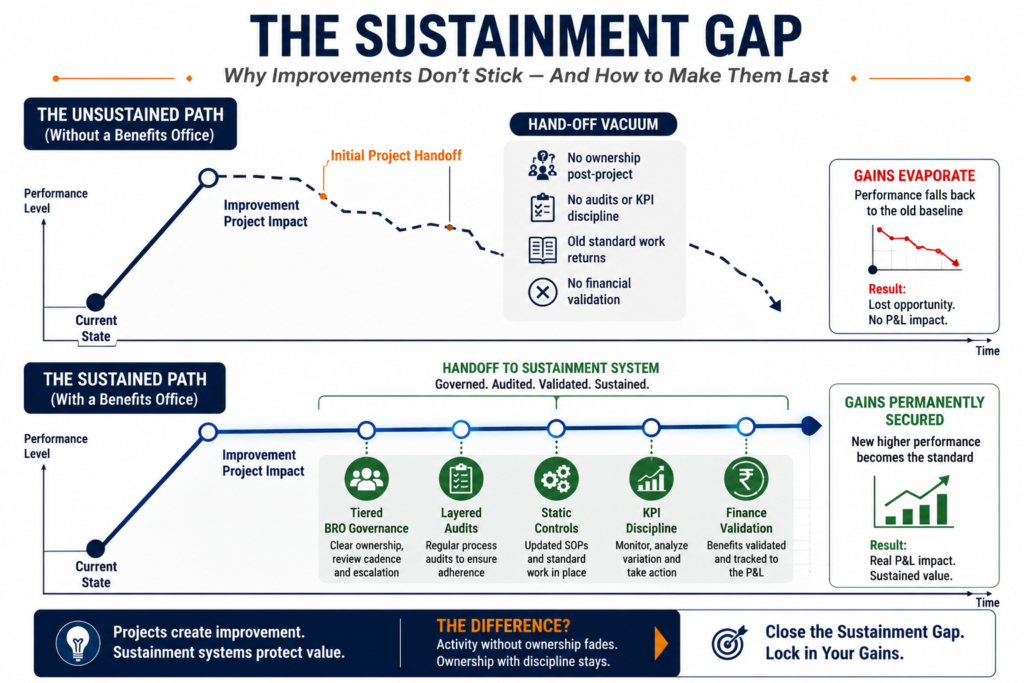
- The Post-Project Hand-off Vacuum: During a Kaizen event, roles are crystal clear. Once the project closes, ownership becomes ambiguous. OpEx teams move to the next fire, and line supervisors assume “someone else” is tracking the trend line.
- Static Standard Work: Process changes are implemented, but Standard Operating Procedures (SOPs), autonomous maintenance logs, and training matrices are never formally updated. New hires are trained the old way; veteran operators revert to comfortable habits.
- The “Audit Flare” Phenomenon: Performance spikes intensively during implementation or right before an executive walkthrough, then degrades when the spotlight moves.
Case in Point: Operational Success vs. Commercial Value
The FMCG Trap: The High-Speed Packaging Win
Consider a beverage bottling facility that runs a highly successful SMED (Single-Minute Exchange of Die) project, slashing a critical line changeover from 90 down to 60 minutes. Standard work is set, tools are staged, and the operational win is real.
Six months later, Plant Finance sees zero impact on manufacturing cost per unit. Why? Production planning never adjusted campaign sizes or scheduling constraints. The extra 30 minutes of unlocked capacity simply resulted in the line sitting idle longer. The operational metric improved, but the commercial value leaked away.
The Pharma Trap: Isolating the Non-Bottleneck
A pharmaceutical formulation plant optimizes its tablet-pressing sequence, successfully reducing batch cycle times and boosting local equipment utilization. However, the site’s overall throughput remains entirely flat. Why? The true bottleneck was a multi-week backlog in QA/QC batch release and deviation investigations. Accelerating production merely piled up Work-in-Progress (WIP) inventory in the staging area, trapping cash without improving customer lead times.
The Executive Lesson: Localized operational improvement does not automatically equal business optimization. Value must be governed across the entire end-to-end value stream.
The Blueprint: The Five Pillars of a Benefits Office
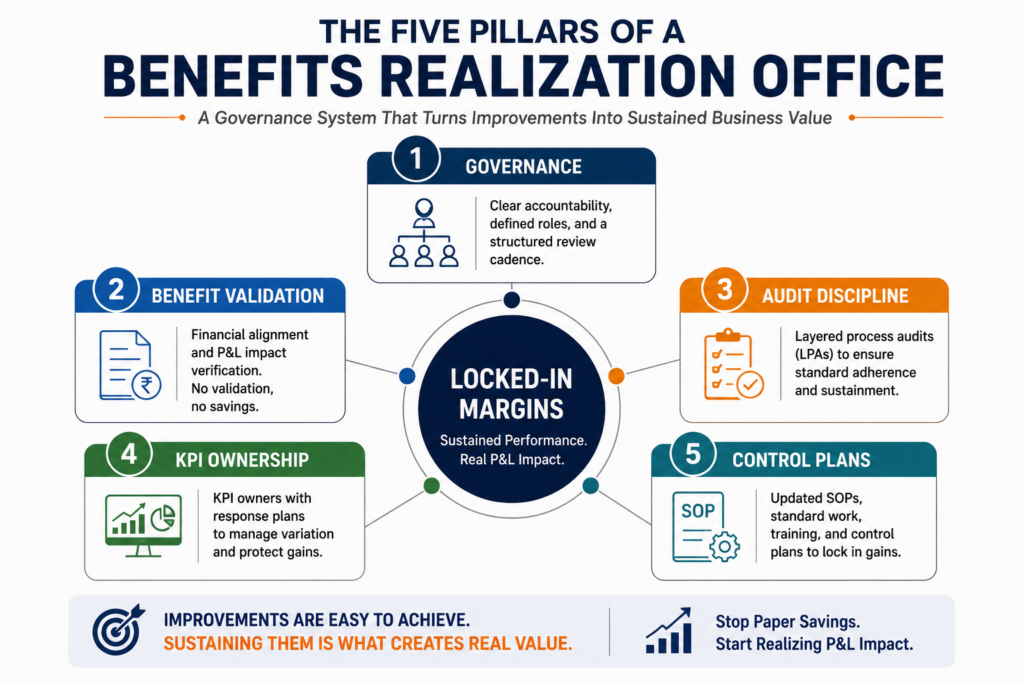
A Benefits Office acts as an objective, cross-functional bridge between Operations, OpEx, and Finance. It replaces activity tracking with absolute value verification through five core pillars:
| Pillar | Focus Area | Manufacturing Execution |
|---|---|---|
| 1. Governance | Accountability | Establishes a rigid, cross-functional review cadence between OpEx and Line Managers to prevent performance drift. |
| 2. Benefit Validation | Financial Alignment | Involves Finance before project kickoff to define the baseline, calculation model, and evidence source. |
| 3. Audit Discipline | Layered Verification | Deploys Layered Process Audits (LPAs): supervisors audit daily, plant heads audit weekly, the Benefits Office audits monthly. |
| 4. KPI Ownership | Operational Response | Assigns explicit metric owners with mandatory, documented reaction plans for when performance dips below the new baseline. |
| 5. Control Plans | Standardization | Hard-codes improvements into dynamic SOPs, visual management systems, and training matrices. |
Leadership’s Role: Moving Past Firefighting
Many leaders treat continuous improvement as a series of isolated projects. The most profitable manufacturing sites treat it as an integrated management system. Executive sustainment means demanding hard evidence over comfortable assumptions. It requires plant leadership to review benefit sustainment metrics with the same uncompromising discipline used for daily safety and shipping targets.
Our industry frequently praises the “hero culture” of individuals who rescue failing situations. But sustainable profitability is driven by leaders who build the governance systems that prevent the regression from happening in the first place.
Does Your Plant Need a Benefits Office?
Ask yourself these diagnostic questions:
- Do your verified lean savings routinely fail to show up in your end-of-year P&L?
- Does your site find itself running the same root-cause workshops on the same lines year after year?
- Do improvements systematically degrade the moment the OpEx team or external consultants exit the floor?
- Does your site leadership lack real-time visibility into the sustained yield of past investments?
If these patterns sound familiar, your plant doesn’t have a capability problem. You have a governance problem.
Lock in Your Margins: Book a 30-Minute Strategy Call
Stop celebrating paper savings while letting true financial value leak off your plant floor. Our Sustainment Retainer helps FMCG and pharmaceutical manufacturers design and install the custom governance architectures, audit disciplines, and financial validation loops needed to secure a permanently higher operating baseline. Book Your 30-Minute Sustainment Scoping Call
Book a Call
Frequently Asked Questions
It is a dedicated governance framework and operational unit that connects plant-floor execution with corporate finance, ensuring Lean, Six Sigma, and digital transformation gains directly impact net profitability.
It is a dedicated governance framework and operational unit that connects plant-floor execution with corporate finance, ensuring Lean, Six Sigma, and digital transformation gains directly impact net profitability.
A traditional PMO tracks milestones and execution schedules (“Is the project on time?”). A Benefits Office tracks value realization and sustainment (“Is the process change still yielding financial fruit 180 days after hand-off?”).
It prioritizes macro financial health indicators, specifically Net Manufacturing Cost per Unit, Validated OEE Dollarization, Material Yield Conversion Rates, and Total Process Lead Time Reduction.