
When a manufacturing plant faces a sudden surge in demand or a drop in quarterly margins, the standard boardroom reaction is almost predictable: “We need to invest in a new assembly line,” or “It’s time to purchase another CNC machine.”
But before you sign off on a massive capital expenditure (CapEx) layout, consider a startling benchmark from global operations data.
According to data compiled by McKinsey & Company, the vast majority of manufacturing facilities run at an actual Overall Equipment Effectiveness (OEE) of just 60% to 65%.
An OEE score of 85% is considered world-class for discrete manufacturers. This means that if you are running at the industry average, more than a third of your existing asset capacity is quietly leaking away into invisible process gaps. Research highlights that a structured approach to OEE improvement can unlock up to 20% in hidden production capacity from your exact same floor footprint—zero machinery investment required.
The competitive question isn’t whether you need more machines. The question is: How do you build a lean production management system to uncover your hidden factory capacity?
The hard math behind floor-level capital leaks
When a plant relies on “thumb-rule” or gut-feeling management, waste isn’t obvious. It doesn’t look like an idle factory floor; it looks like busy workers, stacked containers, and frantic end-of-the-month shipments.
Turn Improvement Opportunities Into Shopfloor Results
Most manufacturers already know where problems exist. The challenge is turning those opportunities into sustained improvements.
In reality, non-standardized workflows breed the traditional 8 wastes of lean manufacturing, which actively drain asset capability:
The Cost of Handoff Hysteria (Waiting & Downtime)
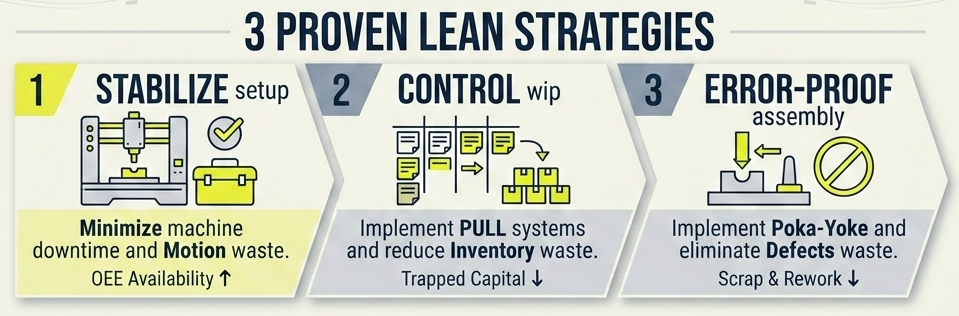
Industry benchmarks show that unplanned downtime and minor stoppages cost industrial manufacturers an estimated $50 Billion annually. If an operator spends just 9 minutes per hour waiting for a material handler, a crane operator, or a tool setup change, you lose 15% of your daily labor capacity before a single part is even stamped. Achieving lasting OEE improvement requires eliminating these micro-stoppages at the workstation level.
The Capital Lock of Overproduction (WIP Inventory Control)
When Station A pushes parts faster than next, Station B can process them; the floor clogs up with half-finished goods. Implementing strict WIP inventory control is critical; holding excess inventory typically bloats annual storage and tracking costs by 20% to 30% of the material's value. You aren't just losing physical floor space; you are literally locking up cash flow in half-finished iron, electronics, or plastic sitting stagnating in a corridor.
The Compounding Margin Bleed (Defects & Rework)
A standard precision engineering plant with a 2.5% rejection rate faces a triple loss: the raw material cost, the machine hours spent processing the scrap, and the labor hours required for rework. Integrating structured lean manufacturing tools and DMAIC disciplines systematically cuts defect rates by up to 50%, feeding straight into your bottom-line profitability.
Rushing to Industry 4.0? The automation trap
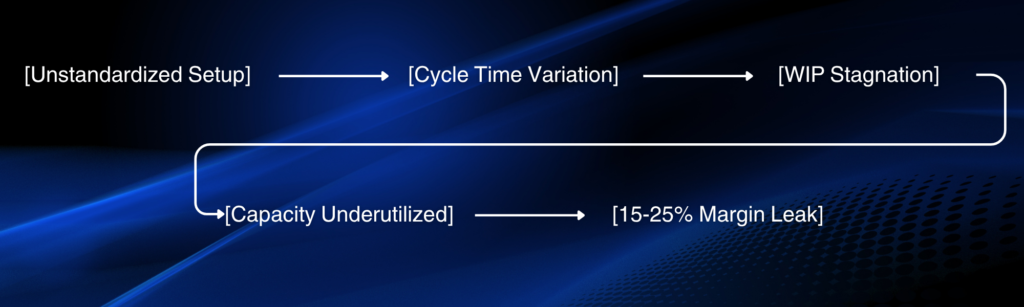
A trending solution in today’s landscape is to leap straight into advanced manufacturing technology or heavy factory IT rollouts. However, recent data highlights a critical reality: nearly 70% of digital lean manufacturing and smart factory pilots fail to scale across facilities when dropped into an unstable, non-standardized operational environment.
Automation is built on a standard lean process. It begins with efficiency and discipline in how work is done. From there:
- Machines are connected through IoT, enabling them to “talk” and share real-time data.
- Reports are integrated with ERP systems and dashboards, allowing information to “speak” clearly across the organization.
In short, automation is not just about tools—it’s about making processes standard, machines intelligent, and data communicative. Everything starts with being standardized and efficient
The SKIL Global roadmap: Unlocking capacity in 12 weeks
At SKIL Global, we specialize in helping industrial companies move away from thumb-rule operational models toward predictable, evidence-based systems. We target hidden shop-floor margins by deploying a rigorous operational excellence framework built around Lean Six Sigma, data visibility, and workplace discipline.
Instead of introducing disconnected spreadsheets or rigid paper trails, we lay down a standardized process foundation that seamlessly prepares your floor for modern lean manufacturing software integration.
Our Implementation Framework
Lean Manufacturing Value Stream Mapping
Weeks 1 - 3
We map out your physical material and information pipelines. By running a thorough value stream mapping exercise, we measure actual cycle times against total calendar time to uncover exactly where parts are sitting idle versus actively gaining value.
Kanban System in Manufacturing
Weeks 7 - 9
We replace chaotic "push" scheduling with strict, visual kanban production systems. Stations are restricted from producing parts unless the downstream queue explicitly triggers demand—instantly establishing robust WIP inventory control.
SMED & 5S Manufacturing Principles
Weeks 4 - 6
We eliminate tool search times and optimize changeovers. By compressing setup times (Single-Minute Exchange of Die) by 30% to 50% using standard 5S lean principles, we turn machine setup hours back into live, productive capacity.
Deploying Real-Time Visual Factory Management
Weeks 10+
We convert floor-level metrics (like Availability, Performance, and Quality) into highly visible, live dashboards right at the workstations. This ensures anomalies or process drift are spotted and corrected within minutes, setting up the perfect data pipeline for future lean manufacturing software enablement.
Reclaim what is already yours
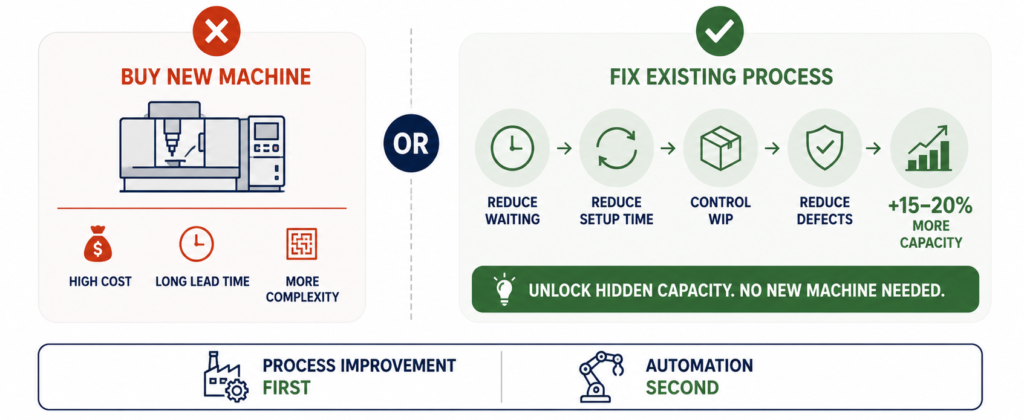
Unlocking the hidden treasure of 15% to 20% more output in existing set up doesn’t require deep financing rounds or waiting six months for a new machine delivery. The capacity is already sitting on your floor—hidden inside erratic setups, mismatched assembly steps, and paper-based tracking silos.
By partnering with SKIL Global, you establish a culture of relentless process discipline, stabilizing your core operations to yield immediate capacity breakthroughs and permanent margin protection.
Instead of introducing disconnected spreadsheets or rigid paper trails, we lay down a standardized process foundation that seamlessly prepares your floor for modern lean manufacturing software integration.
Take the SKIL Global Audit Challenge
If your current Overall Equipment Effectiveness is sitting below 75%, your plant is carrying invisible costs. Let’s sit down, map your value stream, and build an actionable roadmap for structural OEE improvement.