
An organization can have a perfectly structured org chart and still have an ineffective management structure.
As organizations grow, reporting structures often evolve organically. Over time, this can lead to unclear reporting relationships, overloaded managers, inconsistent hierarchies, and limited opportunities for employee development.
One often-overlooked factor behind these challenges is span of control — the number of employees directly reporting to a manager.
There is no universal “right” span of control. It depends on the nature and complexity of work, the capability of employees, the responsibilities of managers, and the degree of process standardization.
However, when a span becomes excessively wide, effective management can become increasingly difficult.
A recent organizational assessment conducted by SKIL Global for a leading real estate company highlighted this challenge. In some areas, managers were responsible for as many as 34–40 direct reportees.
The question was not simply whether the organization needed a new org chart. The more important question was whether the existing structure was enabling managers to effectively manage, develop, and align their teams.
What Is Span of Control?
Span of control refers to the number of employees who directly report to a manager.
A manager overseeing a small, specialized team may be able to effectively manage a different number of employees than a manager responsible for a large, standardized operation.
Several factors influence the appropriate span, including:
- Complexity of work
- Employee experience and capability
- Managerial responsibilities
- Level of supervision required
- Degree of process standardization
- Organizational hierarchy
- Geographic or functional dispersion of teams
This means there is no universally applicable number that defines an effective span of control.
The goal is not to achieve an arbitrary number. The goal is to create a span of control that enables effective management.
When Does Span of Control Become a Problem?
A wide span of control is not automatically ineffective. In highly standardized environments with experienced employees and well-defined processes, managers may be able to effectively oversee larger teams.
The challenge arises when a large number of direct reports is combined with complex responsibilities, frequent decision-making, limited process standardization, or a high need for coaching and supervision.
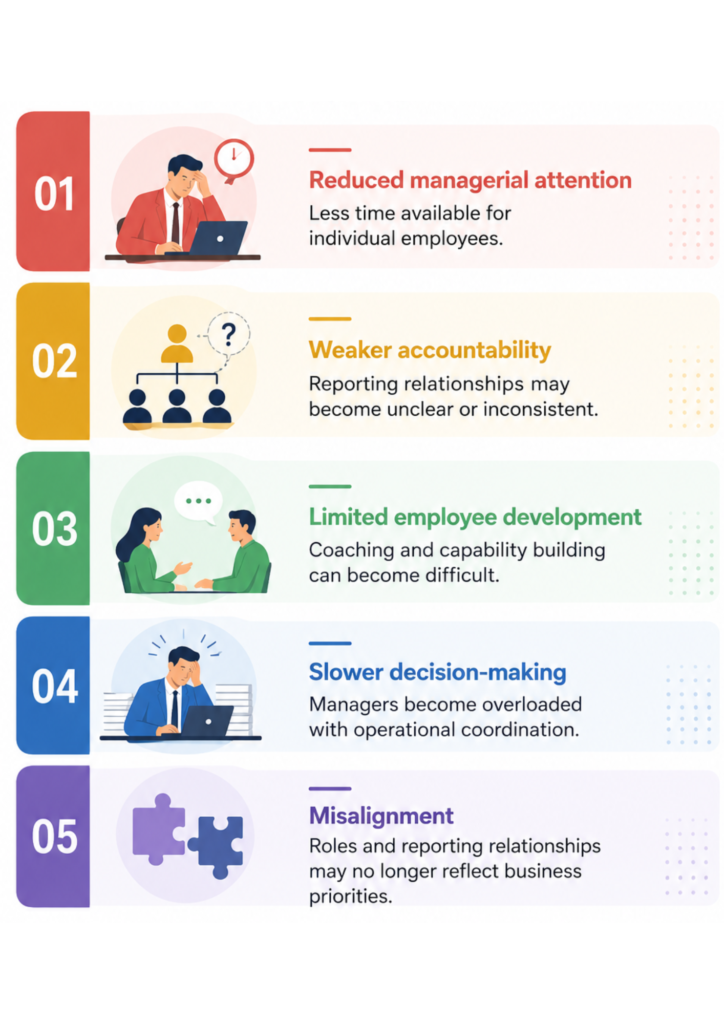
When managers have too many direct reports, they may struggle to:
- Provide timely coaching and feedback
- Monitor individual and team performance
- Resolve issues quickly
- Develop employee capabilities
- Maintain effective communication
- Give sufficient attention to strategic responsibilities
Over time, this can lead to managerial overload, slower decision-making, inconsistent accountability, and reduced opportunities for employee development.
This is why span of control optimization should be viewed as an organizational design decision, not simply an HR exercise.
What Determines the Right Span of Control?
The right span depends on the context in which managers and employees operate. Before changing reporting relationships, organizations should consider:
1. Nature and complexity of work
Complex or highly variable work generally requires more managerial involvement than standardized, repetitive processes.
2. Employee capability and experience
Experienced and capable employees typically require less day-to-day supervision, allowing managers to oversee larger teams.
3. Managerial responsibilities
A manager responsible for strategy, stakeholder management, planning, and performance management may have less capacity for a large number of direct reports.
4. Process maturity
Well-defined processes, clear roles, and standardized ways of working can make larger spans more manageable.
5. Organizational layers
Adding excessive layers can slow decision-making, while excessively wide spans can overload managers. Effective organizational design requires finding the right balance.
How to Optimize Organizational Structure
Effective organizational design begins with understanding how the organization actually operates — not simply how it is supposed to operate.
A practical approach can include five steps:
1. Assess the Existing Structure
Start by mapping the current organization, including reporting relationships, managerial spans, roles, and organizational layers.
This helps identify where reporting structures may have become inconsistent or where managers may have an unusually high number of direct reports.
1. Assess the Existing Structure
Start by mapping the current organization, including reporting relationships, managerial spans, roles, and organizational layers.
This helps identify where reporting structures may have become inconsistent or where managers may have an unusually high number of direct reports.
2. Analyze the Gaps
The next step is to understand why those structures exist.
Are reporting relationships aligned with actual responsibilities? Are managers carrying excessive administrative or supervisory loads? Are there duplicated roles or unclear accountabilities?
The objective is to identify structural gaps rather than simply reduce or increase the number of direct reports.
3. Engage Functional Leaders
Organizational structures cannot be designed effectively from an org chart alone.
Engaging HODs and functional leaders helps validate how work actually flows, where decision-making takes place, and what changes would be practical for the organization.
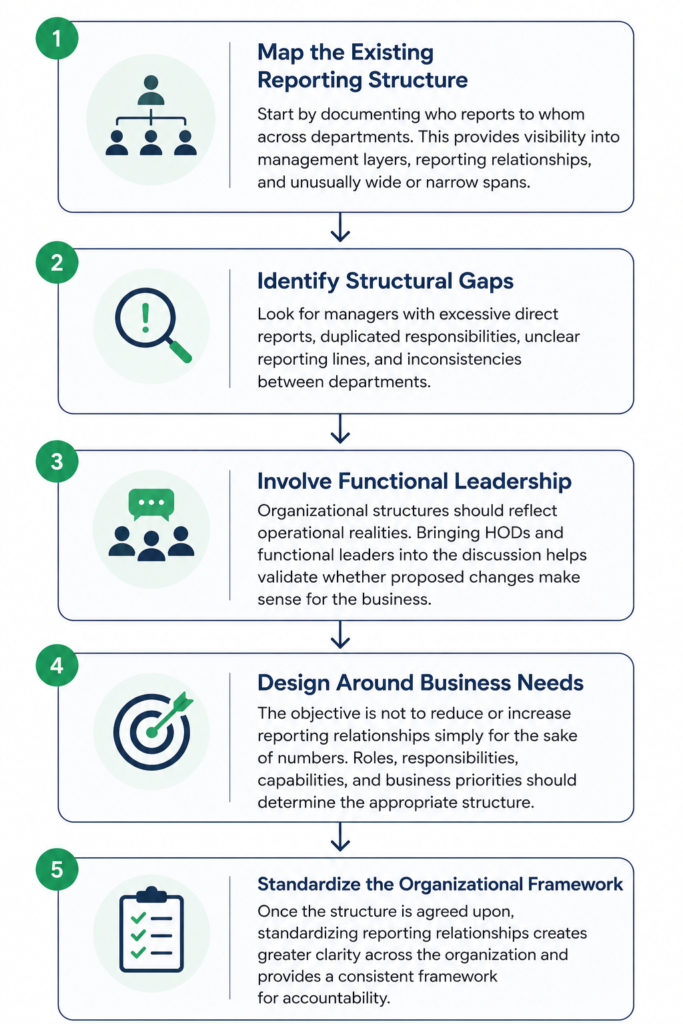
4. Redesign the Structure
Based on the assessment and stakeholder input, reporting relationships can be redesigned to create clearer accountability and more manageable managerial spans.
The focus should be on aligning the structure with business requirements rather than applying a fixed span-of-control benchmark.
5. Standardize and Sustain
Once the structure is agreed upon, the organization needs a standardized representation of roles and reporting relationships.
This creates clarity for employees and provides leadership with a consistent reference point as the organization continues to evolve.
A Real-World Example
During an organizational assessment for a leading real estate company, SKIL Global found that the existing org chart and reporting mechanisms were not standardized.
Several managers had extremely wide spans of control, with some managing 34–40 direct reportees.
Rather than simply recommending structural changes, SKIL Global facilitated a brainstorming session involving the organization’s HODs. The existing structure was reviewed, reporting relationships were evaluated, and the practical implications of different structural options were discussed.
Based on these inputs, a standardized proposed organizational structure was developed with a focus on creating more manageable reporting relationships. The resulting structure provided greater clarity around:
- Reporting relationships
- Accountability
- Managerial capacity
- Alignment with business goals
- Employee development opportunities
The exercise demonstrated an important principle: organizational design should reflect how the business needs to operate, not simply how it has operated in the past.
Beyond the Org Chart
An org chart shows who reports to whom. But an effective organizational structure needs to do much more.
It should help managers manage effectively, employees understand accountability, and leadership align people capabilities with business priorities.
Organizational restructuring is therefore not about simply moving boxes around on a diagram.
The real objective is to create a structure that supports effective decision-making, manageable leadership responsibilities, clear accountability, and sustainable growth.
The right structure doesn’t just define who reports to whom. It creates the foundation for how effectively an organization can operate and grow.
Is Your Organizational Structure Holding You Back?
If managers are overloaded, reporting relationships are unclear, or your org chart no longer reflects how the business operates, it may be time to assess your organizational design.
SKIL Global can help identify span-of-control gaps, evaluate reporting structures, and develop an organizational framework aligned with your business goals.
Build a structure that helps your people — and your business — perform better.
FAQs
Span of control optimization is the process of evaluating how many employees report directly to each manager and restructuring reporting relationships to improve managerial effectiveness and organizational performance.
Span of control influences managerial workload, communication, employee support, accountability, and the number of management layers within an organization.
Organizations can begin by mapping the current org chart, identifying unusually wide or narrow spans, reviewing role responsibilities, engaging functional leaders, and redesigning reporting relationships around business needs.
Common indicators include managers struggling to provide adequate employee support, limited coaching time, delayed decisions, unclear accountability, and difficulty developing team capabilities.
Yes. A well-designed reporting structure can create clearer accountability and give managers greater capacity to coach, guide, and develop employees.
No. The appropriate span depends on the complexity of work, employee experience, manager capability, degree of standardization, and the level of supervision required.