Why OEE Feels Stuck
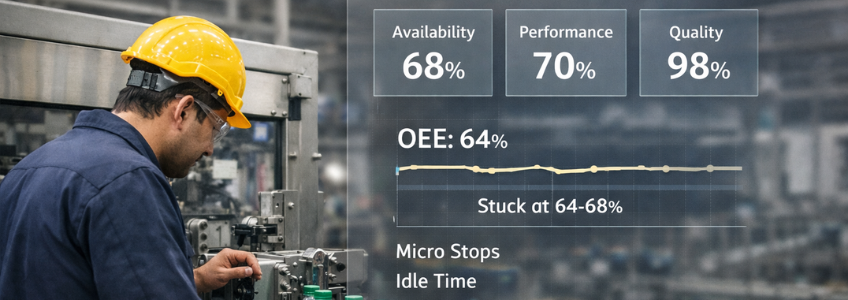
Most plants are not short of improvement initiatives. Teams track OEE regularly, review downtime, and push for better performance across shifts.
Yet, the number barely moves.
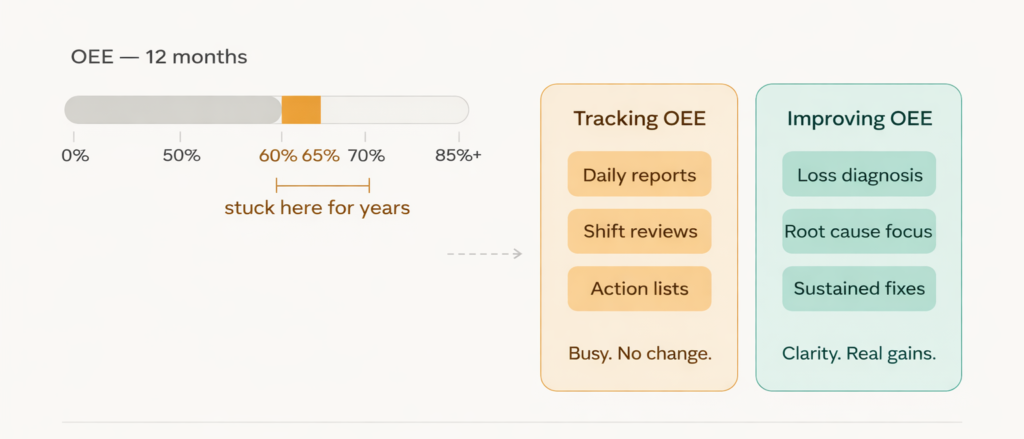
It stays within a narrow range — 60%, 65%, sometimes touching 70% — but never improving in a sustained way. What makes this more frustrating is that there is no lack of effort. Teams are busy, actions are being taken, and reviews are happening.
But the outcome does not match the effort.
Over time, this gap starts showing up in ways that matter — missed production targets, underutilized capacity, and rising cost per unit.
What This Looks Like on the Shop Floor
In a North India brewery, the packaging line had been operating at around 75% availability for months. The team was aware of frequent stoppages and had already taken steps to address breakdowns.
However, the day-to-day reality looked different:
- Small, recurring stoppages continued across shifts
- Recovery time varied depending on who was handling the issue
- Maintenance actions were largely reactive rather than pattern-driven
Despite consistent effort, throughput remained constrained and cost per case continued to increase.
This is not an isolated situation. It is a pattern seen across many FMCG plants, especially in high-speed packaging operations.
Where the Losses Actually Hide
The challenge is not that losses do not exist. It is that they are not fully visible or structured in a way that leads to action.
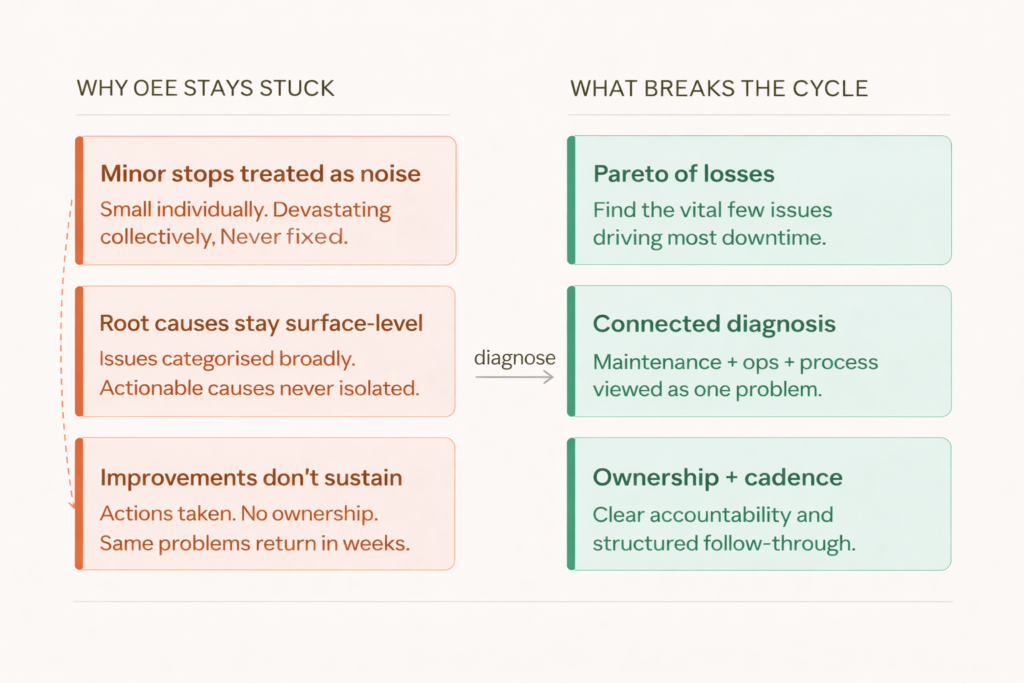
In most plants, three patterns tend to repeat:
- Minor stops are treated as background noise
Individually small, but together they consume a significant portion of productive time.
- Root causes remain at a surface level
Issues are broadly categorized, but not broken down into actionable causes that can be eliminated.
- Improvements do not sustain
Actions are taken, but without ownership and follow-through, the same problems return within weeks.
This creates a cycle where teams respond quickly, but never fully resolve the underlying issues.
What Changes When You Look Deeper
A different outcome starts with a different approach.
Instead of immediately acting on visible problems, a diagnostic approach focuses on understanding where performance is actually being lost. This means stepping back and structuring losses in a way that reveals patterns, not just incidents.
Typically, this involves:
- Building a clear Pareto of downtime and speed losses
- Identifying the few recurring issues that drive the majority of impact
- Connecting maintenance, operations, and process factors instead of treating them separately
- Establishing ownership and a review cadence to ensure actions are closed and sustained
The shift is not about doing more.
It is about solving the right problems, in the right way.
What Happened When the Approach Shifted
The brewery mentioned earlier took this approach.
Instead of launching new initiatives, the team focused on diagnosing losses in a structured way. A detailed breakdown revealed that a small number of recurring issues were responsible for most of the downtime.
The actions that followed were targeted and disciplined:
- MTTR reduction across filler and packaging equipment
- Pareto-based breakdown analysis
- Preventive maintenance aligned to actual failure patterns
- Structured Kaizen actions to eliminate chronic losses
The impact was significant:
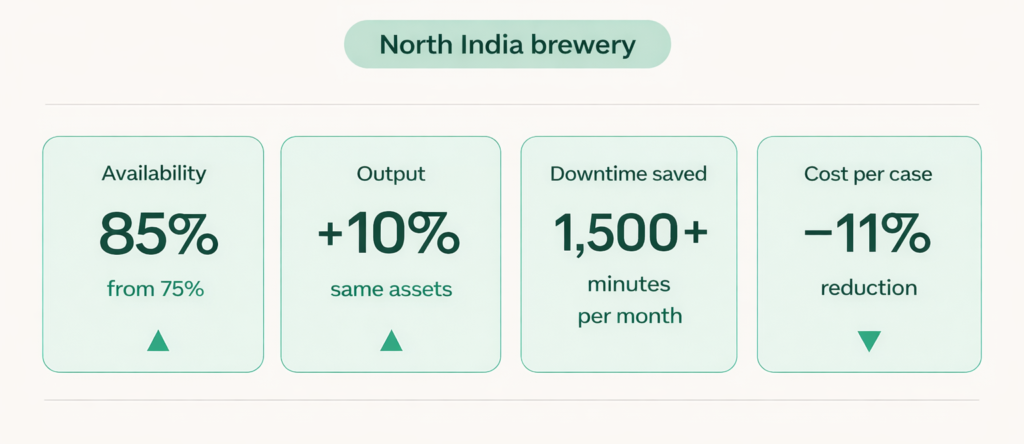
- Availability improved from ~75% to 85%
- Production output increased by 10% with the same assets
- Over 1,500 minutes of downtime eliminated
- 11% reduction in cost per case
More importantly, the improvements were sustained because they were built on clear diagnosis and consistent execution.
The Question That Matters Now
OEE does not improve simply because more actions are taken. It improves when the right losses are identified and systematically eliminated.
In many plants, the opportunity is not in doing more — but in seeing clearly.
The question is:
are you solving the real constraints in your plant, or just the visible ones?
If you want to assess this objectively, a structured diagnostic checklist can help you identify gaps in:
- Loss visibility
- Root-cause analysis
- Execution discipline
Download the Diagnostic Checklist
Use it to evaluate where your plant stands and uncover improvement opportunities that are often missed in day-to-day operations.
For plants looking to go a step further, a structured diagnostic discussion can help translate these insights into a clear improvement roadmap.
Book a 20-minute Diagnostic Call
This is a focused discussion on your current challenges, where we help identify the highest-impact areas for improvement.