

When a plant struggles to meet production targets, the conversation usually turns quickly to capacity.
Maybe the line is too old.
Maybe the plant needs another machine.
Maybe it is time to invest in new equipment.
In some cases, that is valid. But in many plants, the issue is not the lack of equipment. It is the gradual accumulation of small operational losses that reduce the performance of the assets already in place and make it difficult to reduce manufacturing losses in a structured way.
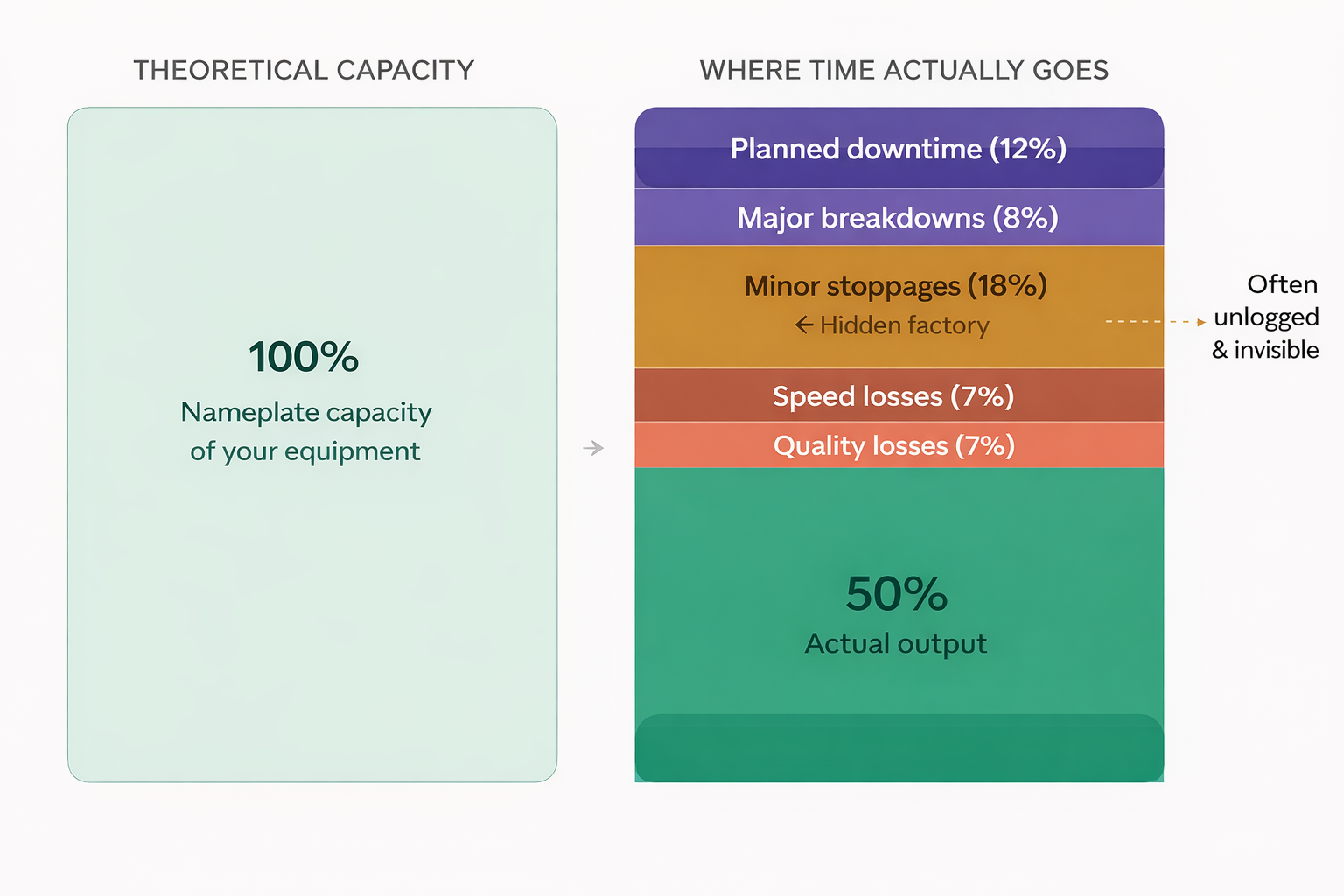
Most plants are not running at their true capacity. Not because they cannot, but because part of that capacity is quietly lost during daily operations.
People often refer to this as the Hidden Factory — the production capacity that exists but never gets realized.
In most plants, the fastest way to reduce manufacturing losses is not through new investment, but by identifying where time and output are already being lost.
How Hidden Losses Build Up in Daily Operations
Major breakdowns are easy to notice and usually get immediate attention.
The more difficult problem is everything that does not stop the line completely.
Short stoppages.
Minor adjustments.
Quick resets that take longer than expected.
Small process variations that require intervention.
Individually, these events do not look serious. The line restarts, and production continues.
But across a full shift, these interruptions add up. Over time, they reduce the actual operating time of the line far more than most reports suggest and directly impact your ability to improve manufacturing efficiency.
In many plants, this results in a significant gap between what the equipment is capable of doing and what it actually delivers.
Example from FMCG Manufacturing: Packaging Line Inefficiencies
In FMCG environments, packaging lines often become the limiting factor for output.
Upstream processes such as mixing or filling may run as expected, but packaging operations tend to deal with frequent small disruptions.
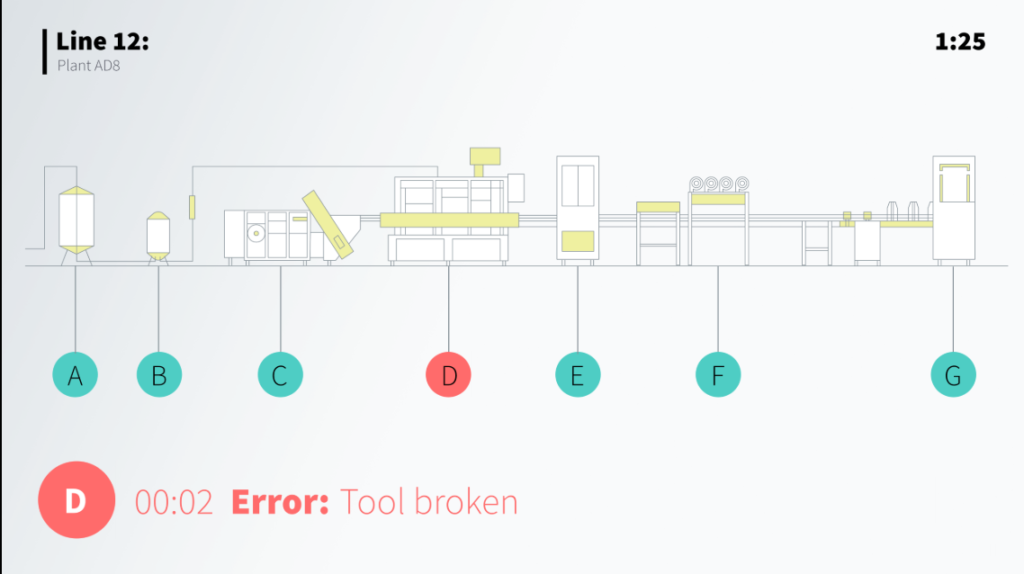
Typical examples include sensor interruptions, material jams, repeated adjustments to labeling or sealing equipment, and short stops to stabilize product flow.
These are usually resolved quickly by operators, which is why they rarely get much attention.
However, the frequency of these interruptions is what creates the problem. Over the course of a shift, they reduce line availability more than expected.
It is not uncommon to see a packaging line designed for high performance operating closer to 70–75 percent availability, even though no major breakdowns are reported.
From a distance, the line appears to be running. In reality, it is underperforming.
Why These Losses Are Often Difficult to Identify
Hidden factory losses usually sit in the gaps between functions — where no one fully owns the problem end-to-end.
Production focuses on keeping the line running and meeting daily targets. Maintenance prioritizes major failures and planned work. Quality focuses on compliance.
Each team is doing its job, but the overall pattern of lost time across the line is rarely examined in a structured way.
Data systems do not always help. Many short stoppages are not logged in detail, and downtime categories are often too broad to reveal meaningful patterns.
The Part No One Talks About
There is also a more practical reason these losses continue.
In most plants, production and maintenance do not see the same problem in the same way.
Production teams often feel that maintenance response is slow or that recurring issues are not permanently resolved.
Maintenance teams often see repeated stoppages as the result of how equipment is being operated.
Over time, this creates a cycle.
The line stops.
Production restarts it.
Maintenance is called only when the issue becomes more serious.
The same problem shows up again in the next shift.
Everyone is working hard, but the root cause never really gets addressed.
This is why many plants feel busy all the time but still struggle to improve performance.
How a Diagnostic Approach Reveals What’s Actually Happening
A structured diagnostic is not just about analyzing data. It is about understanding how the line actually behaves.
It starts with production, downtime, and maintenance data to identify recurring patterns. Pareto analysis helps highlight which issues are responsible for the largest share of lost time.
But the real value comes from combining this with direct observation of the line.
Watching how the line runs, where it slows down, how often it stops, and how teams respond provides a level of clarity that reports alone cannot offer.
A good diagnostic also brings production, maintenance, and engineering into the same discussion using real data and real observations.
Instead of relying on assumptions or past experience, teams begin to look at the same evidence — where time is being lost, how often it occurs, and why.
This is where most plants see the biggest opportunity for plant productivity improvement, by focusing on the losses that actually impact output and taking structured steps to reduce manufacturing losses.
Case Insight: Improving Bottling Line Availability
In one North India brewery, a bottling line had been operating at around 75 percent availability.
The plant was managing to meet production requirements, but only with constant effort from operators and frequent interventions on the packaging line.
A structured diagnostic was conducted to understand where time was being lost.
The analysis identified recurring stoppages across the packaging process and delays in addressing certain equipment-related issues. Individually, these interruptions did not appear critical. Together, they represented a significant loss of productive time.
After focused improvements were implemented:
- Line availability increased to 85 percent
- More than 1,500 minutes of downtime were eliminated
- Production output increased by approximately 10 percent
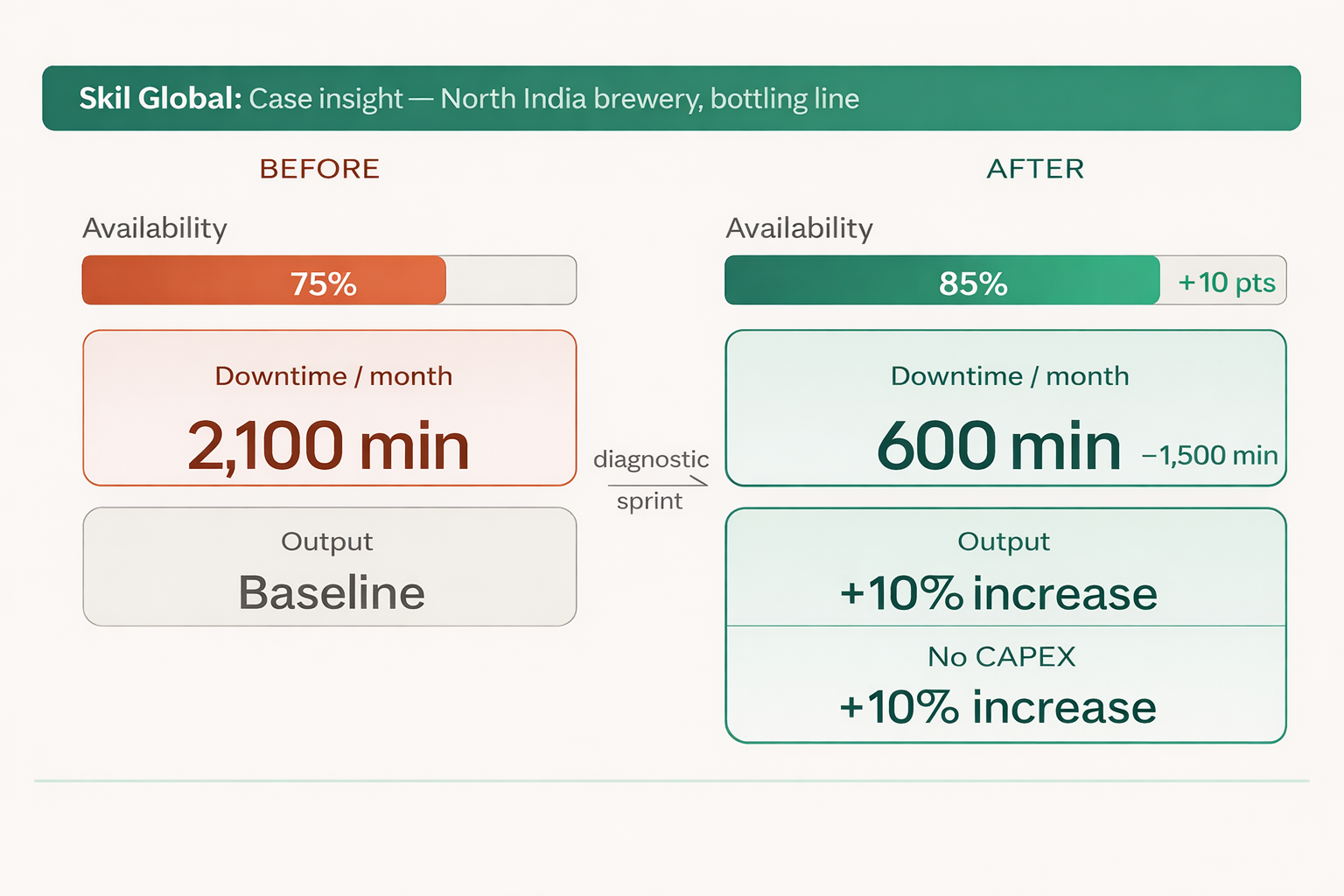
No additional equipment was required.
What changed was not just the line performance, but how the team understood and addressed recurring issues across production and maintenance.
Why Diagnostics Should Come Before Improvement Programs
Many plants introduce improvement initiatives with the intention of increasing productivity.
These efforts can deliver results, but they are most effective when they focus on clearly identified operational constraints.
Without first understanding where the largest losses occur, improvement efforts often become spread across multiple areas. This makes it difficult to achieve meaningful and sustained impact.
A diagnostic helps narrow the focus to the issues that matter most and creates a more direct path to improve manufacturing efficiency.
A More Practical Way to Look at the Problem
If your plant feels like it is constantly working hard but not making the expected progress, the issue is rarely a lack of effort.
Most teams are already aware of the problems on the floor.
What is often missing is a clear and shared understanding of where the biggest losses actually are — and which ones matter most.
That clarity is what allows teams to move beyond firefighting and start working systematically to reduce manufacturing losses and improve overall plant performance.
Identify Hidden Losses in Your Plant
Most plants know losses exist. The challenge is knowing where to look first and what actually matters.
We’ve put together a practical Manufacturing Diagnostic Checklist based on how we assess plants during our diagnostic sprints.
It helps you quickly evaluate:
- Where production time is being lost across your lines
- Which losses are not being captured in current reports
- Where to focus for immediate impact
- How to start reducing recurring inefficiencies
Download the Manufacturing Diagnostic Checklist
Want a Clearer View of What’s Limiting Your Plant?
If you’re looking beyond a checklist and want a structured view of where capacity is being lost, a focused diagnostic can help bring clarity.
At Skil Global, our Operational Diagnostic Sprint looks at:
- Actual line behavior, not just reports
- Recurring loss patterns across production and maintenance
- The few issues that are truly limiting output
If you’re exploring ways to reduce manufacturing losses and improve plant productivity, it may be worth understanding whether a structured diagnostic approach would make sense for your plant.