
If you’re running a manufacturing plant, you’ve probably had this moment.
You walk the floor, look at the numbers, and think:
“We’ve tried everything… so why isn’t performance moving?”
- OEE is stuck
- Each shift runs the line differently
- The same breakdown shows up every week — just at a different time
And every morning, the meeting sounds the same.
- Production explains
- Maintenance explains
- Quality adds context
By the time it’s over, nothing is really solved — just carried forward.
At some point, it becomes clear:
This isn’t a strategy problem.
It’s an execution problem.
Why Most Improvement Efforts Don’t Stick
Most plants are not short of ideas. In fact, they usually have too many.
There are Lean initiatives, past Kaizens, trackers, dashboards — all in place.
But on the shop floor, reality looks different:
- People are firefighting
- Supervisors are stretched
- Operators are doing what works in the moment
And improvement gets pushed to “when things are stable” —
which never really happens.
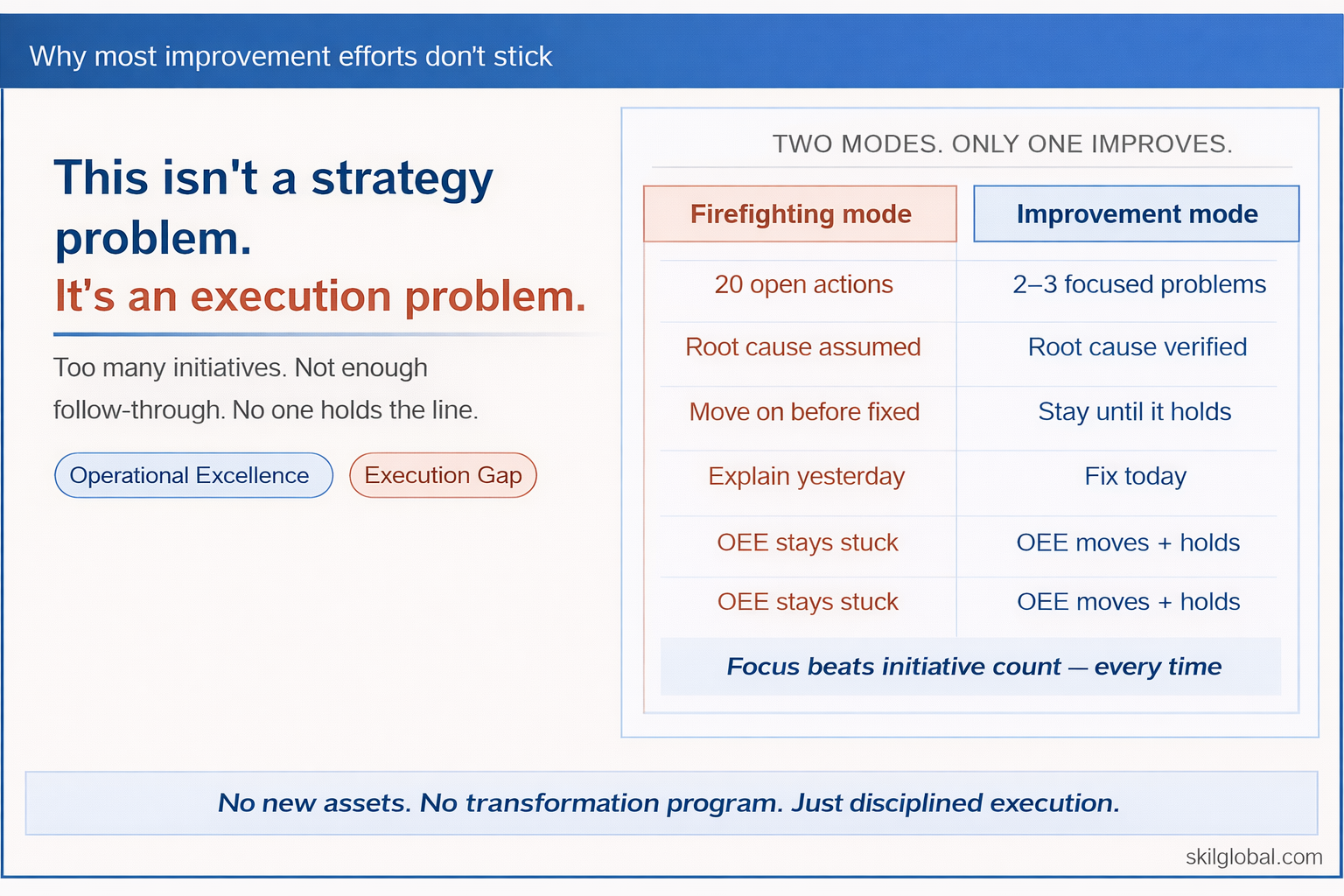
What breaks most efforts is not intent, but lack of focus and follow-through.
- Too many problems taken up at once
- Root causes assumed, not verified
- Teams move on before problems are actually solved
So the plant keeps moving — but not improving.
The Truth About “90-Day Improvement”
Let’s be honest — no plant runs on a perfect 90-day plan.
There will be disruptions:
- A machine fails at the worst time
- A material issue throws off schedules
- One shift undoes what another fixed
The goal is not to follow a clean timeline.
The goal is to hold focus on a few problems long enough to fix them.
Most plants don’t need 20 initiatives.
They need to:
- Pick one line hurting performance
- Stay there
- Fix it until it stabilizes
What Actually Changes When Execution Works
When execution starts working, the plant doesn’t suddenly become calm.
But something shifts.
Instead of chasing everything, the team locks onto a few issues and stays with them.
The morning meeting changes:
- Less explaining yesterday
- More focus on what is being fixed today
- Clear ownership of problems
Problems stop moving between departments.
They start getting solved end-to-end.
And slowly, the noise reduces.
Not because the plant is easier —
but because fewer problems keep repeating.
Where Most Improvements Break: The Shift Change
Most losses don’t happen during the day.
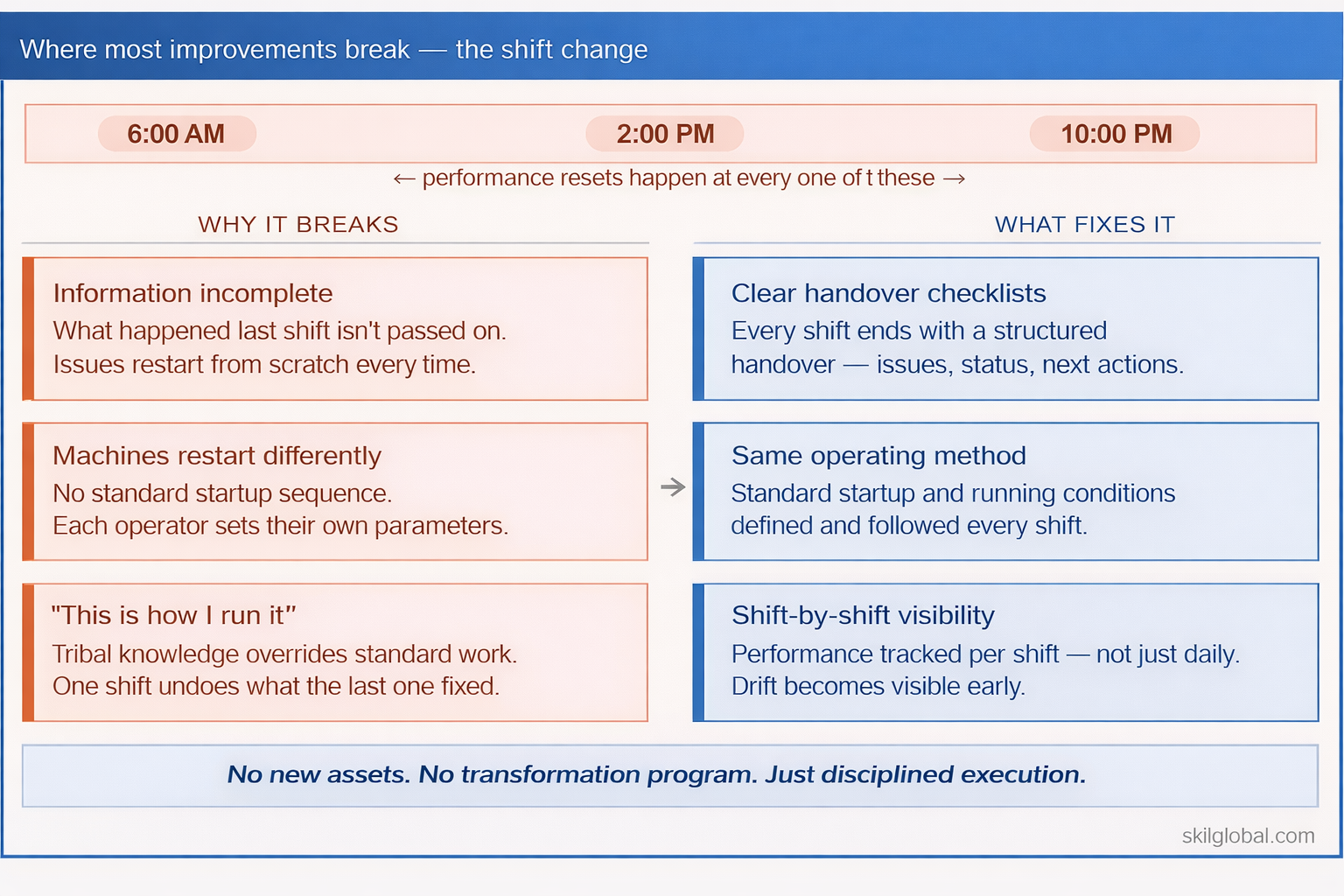
They happen at:
- 6:00 AM
- 2:00 PM
- 10:00 PM
That’s where things reset.
- Information is incomplete
- Machines don’t restart the same way
- “This is how I run it” overrides standard work
So one shift stabilizes the line…
and the next one disturbs it again.
If improvement doesn’t survive the shift change, it won’t last.
Fixing this requires discipline:
- Clear handover checklists
- Same operating method across shifts
- Visibility of performance shift-by-shift
Case Insight: What 90 Days Actually Looked Like
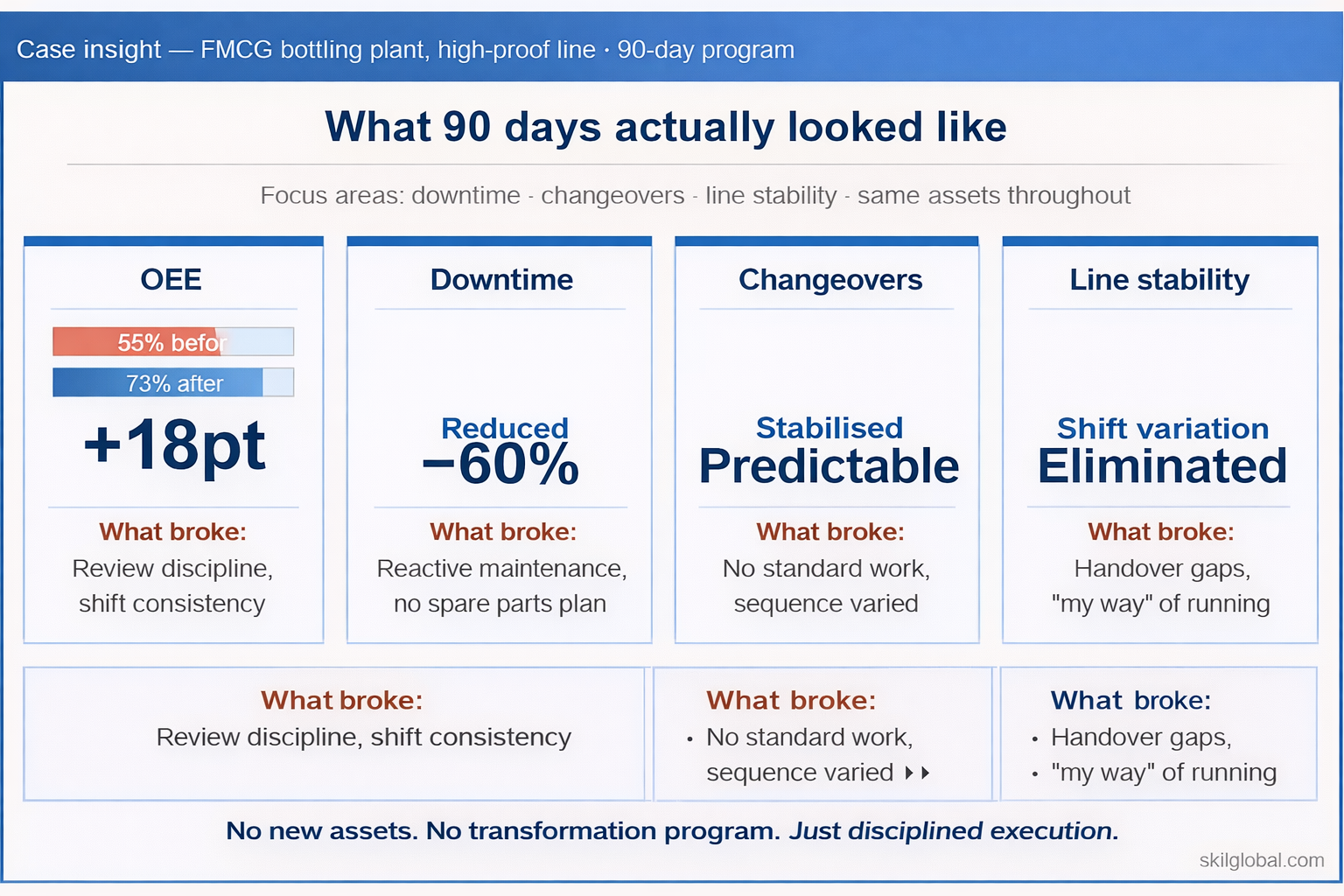
In one FMCG bottling plant, a high-proof line was running at about 55% OEE.
This wasn’t new. The team had already tried multiple improvement efforts.
Some worked — briefly. Most didn’t last.
When the 90-day program started, nothing dramatic changed on Day 1.
There were still:
- Breakdowns
- Delays
- Resistance from teams used to “their way”
But one thing was different:
The team didn’t move on.
They stayed focused on a few critical issues:
- Downtime
- Changeovers
- Line stability
And they worked them until results held.
Over time:
- The line became more predictable
- Interruptions reduced
- Shift-to-shift variation decreased
Within ~90 days:
- OEE improved from 55% to 73%
- Throughput increased
- No additional assets were required
What made this possible:
- Better spare parts availability for critical equipment
- Stabilized utilities (air, power, water)
- Reduced reactive maintenance
- Stronger coordination between teams
Nothing revolutionary.
Just disciplined execution.
What This Means on the Shop Floor
This kind of improvement doesn’t come from presentations.
It shows up in consistent actions:
- Short, focused weekly reviews
- Supervisors spending time on the line
- Faster problem resolution
- Clear ownership of issues
And one key decision:
“We are not moving to the next issue until this one holds.”
That’s where most programs fail.
A Practical Starting Point
If you’re thinking about where to begin, don’t add more.
Narrow down.
Ask:
- Which line is hurting your P&L the most?
- Which problem shows up every week?
- What is consuming the most team time?
Start there. Stay there. Fix it fully.
Download: 90-Day Improvement Playbook
To help you move from identifying losses to seeing real shopfloor results, we’ve created The 90-Day Playbook. This practical guide is designed for plant leaders and improvement teams to turn opportunities into measurable KPI movement.
What’s Inside the Roadmap:
- Phase 1 (Days 1–15): Charter initiatives and align governance.
- Phase 2 (Days 16–30): Validate root causes and design solutions.
- Phase 3 (Days 31–60): Execute improvements and track KPI movement.
- Phase 4 (Days 61–75): Validate benefits with evidence and close gaps.
- Phase 5 (Days 76–90): Embed controls, train teams, and hand over sustainment.
[Download the 90-Day Improvement Playbook →]
Does your current improvement process include a structured weekly governance rhythm, or is it mostly driven by monthly reviews?
Execution Is a Leadership Decision
Most plants don’t fail because they don’t know what to do.
They fail because:
- Too many priorities
- Not enough follow-through
- No one holds the line
Operational excellence is not built through tools.
It is built when someone decides:
“We will fix this — and not move on until it stays fixed.”
Because in manufacturing:
Strategy is decided in the boardroom.
Performance is decided on the shop floor.
If You’re Looking to Structure This in Your Plant
If you’re trying to move from firefighting to focused execution,
it helps to step back and structure the approach.
At Skil Global, we work with manufacturing teams on 90–120 day improvement programs built for real plant conditions.
If it helps, we can walk through how this could look in your plant.
No pitch. Just a practical conversation.
👉Schedule a 45-min Scoping Call →