
The Problem That Doesn’t Trigger Maintenance Action
In most plants, maintenance teams are geared to respond to breakdowns. When a machine stops for an hour, it is a recorded problem. When it runs, it is considered healthy.
But between these two states lies a dangerous “Grey Zone”: Equipment that is running—but not stable.
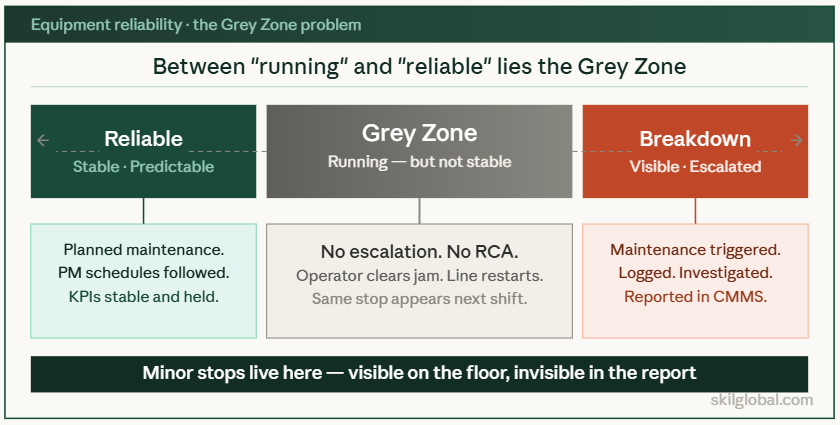
Minor stops fall into this category. They don’t trigger maintenance escalation and they don’t appear as major downtime. But they indicate something critical:
The equipment is no longer operating reliably. Over time, this instability reduces performance and quietly erodes your OEE.
What This Looks Like in Real Operations
Consider a high-speed packaging line. On paper, maintenance reports show “acceptable” downtime. Availability looks stable. But the floor reality is a state of micro-chaos:
- Frequent 30-second stoppages across all shifts.
- Operators intervening manually to “nudge” the machine back to life.
- The same sensor or feeder issues appearing daily without formal escalation.
The machine was running, but it was not reliable. In high-speed lines, failures are rarely catastrophic at first; they are frequent, small, and repetitive.
⚡ Program Note: The A2 90–120 Day Improvement Program
Our A2 program focuses on closing the Feedback Loop between Operations and Maintenance. We don’t just fix “jams”; we execute 2–4 priority initiatives to embed sustainment controls, validate financial benefits, and turn equipment instability into Predictable Performance.
Why Minor Stops Are a Maintenance Problem
Minor stops are often dismissed as “operational nuances.” In reality, they are early failure signals. Three root causes typically drive this:
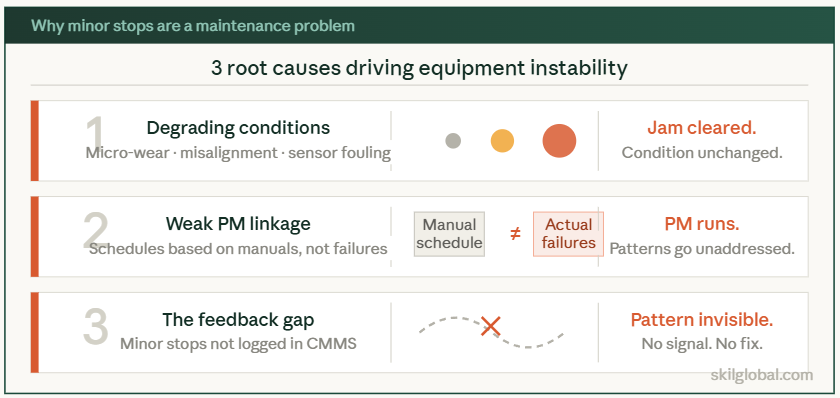
- Degrading Equipment Conditions: Micro-wear, slight misalignments, and sensor fouling lead to repeated interruptions that “clearing the jam” doesn’t fix.
- Weak PM Linkage: Preventive Maintenance schedules are often based on manual recommendations rather than actual failure patterns observed on the floor.
- The Feedback Gap: Frequent minor issues are rarely captured in the CMMS, so the Maintenance team never addresses the root cause systematically.
The result? Equipment continues to run, but reliability keeps declining until a major breakdown occurs.
Case Insight: Improving OEE Through Reliability
In a biscuits manufacturing plant, the packaging line was consistently under-target despite having “low” formal downtime.
The Shift: We moved from “clearing stops” to Reliability-Driven Improvement.
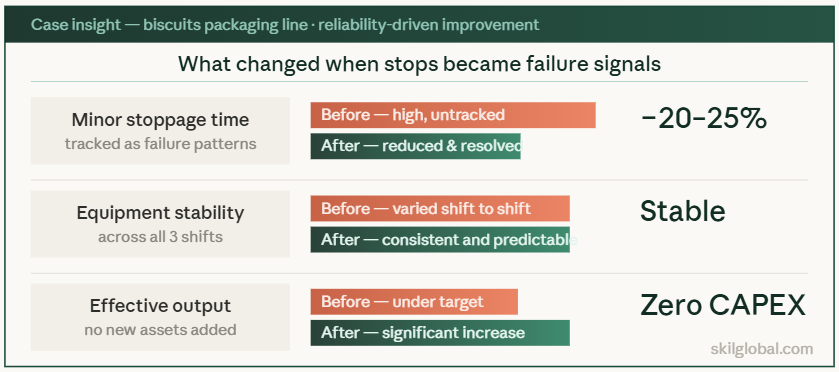
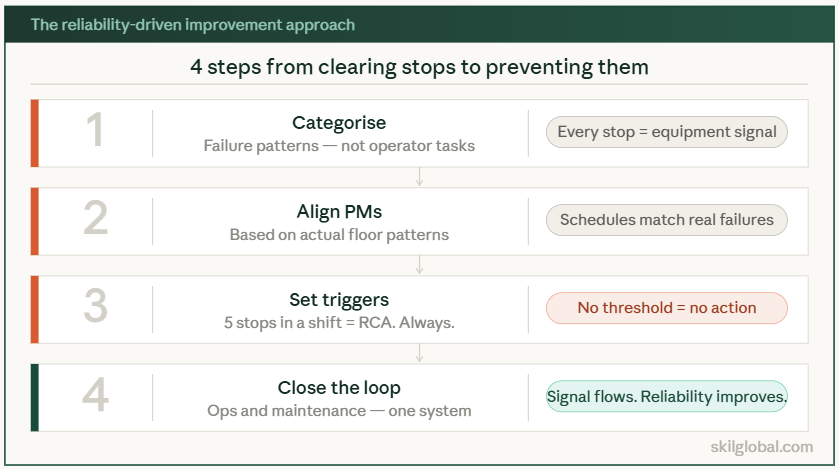
- Categorization: Minor stops were tracked as equipment failure patterns, not just “operator tasks.”
- Alignment: Maintenance PMs were redesigned based on actual recurring micro-stoppages.
- Governance: A standard escalation trigger was set: if a minor stop occurs more than 5 times in a shift, it triggers a Root Cause Analysis (RCA).
The Impact:
- 20–25% reduction in total minor stoppage time.
- Improved Stability: Equipment performance became predictable across all shifts.
- Throughput: Significant increase in effective output with zero additional assets.
Stabilize Your Equipment. Protect Your Gains.
If your plant has low formal breakdowns but inconsistent output, the issue isn’t downtime—it’s Equipment Reliability. And your minor stops are the earliest warning signal.
1. Build a Reliability-Driven Framework (Free Download)
Stop the “spike-and-decay” cycle of improvement. Without sustainment, gains quickly slip back. Download our roadmap to see how we embed standard work, reaction plans, and audit cycles to lock in a new baseline.
2. Translate Reliability into P&L Results
Ready to move from “firefighting” to a structured 90–120 day improvement program? Let’s identify your priority initiatives.
👉 [Book a 45-Minute Improvement Program Scoping Call]