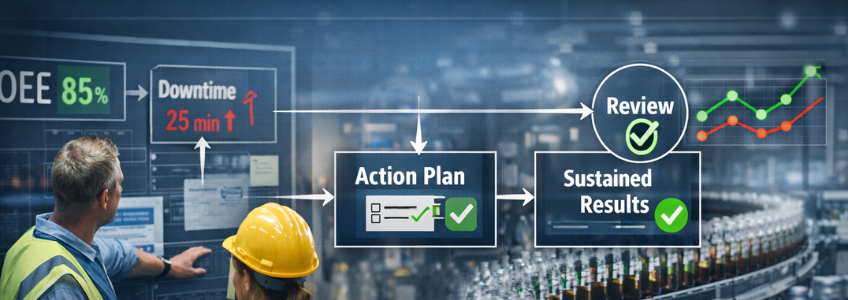
The Illusion of Improvement
Most plants don’t fail because they lack improvement projects.
They fail because those improvements don’t last.
Kaizens are conducted. Projects are launched. Teams are trained.
Yet, months later, performance quietly drifts back to baseline.
The solutions weren’t wrong —
the system to protect them didn’t exist.
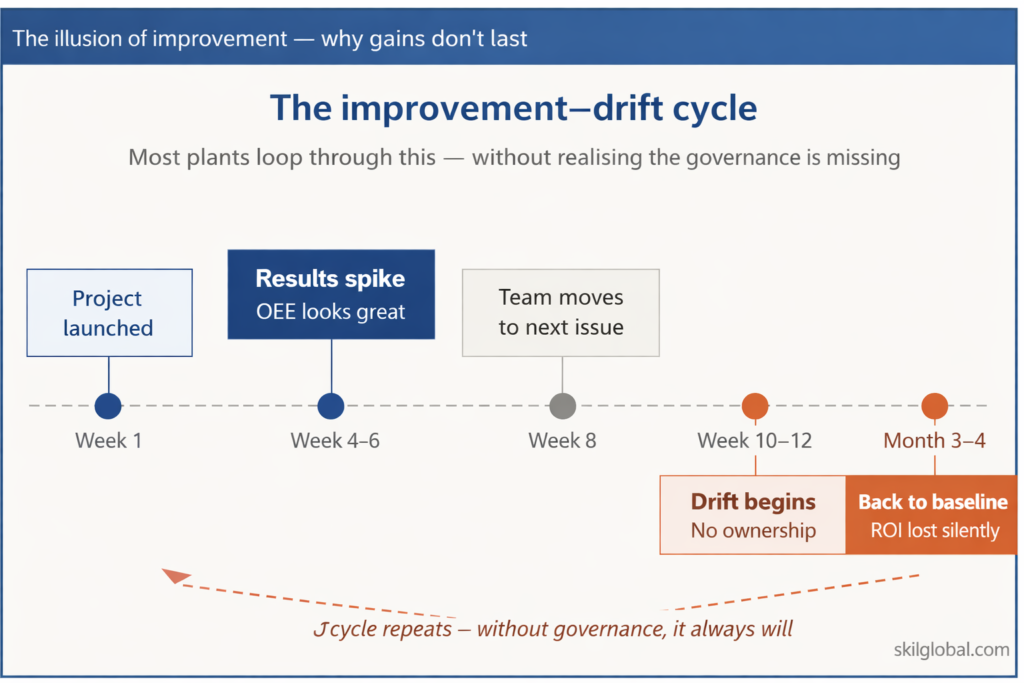
In many plants, improvement is treated as an event.
But sustained performance requires a management system.
The Three Gaps That Break Your ROI
The failure is rarely in technical execution.
It’s in governance discipline.
We consistently see three critical gaps:
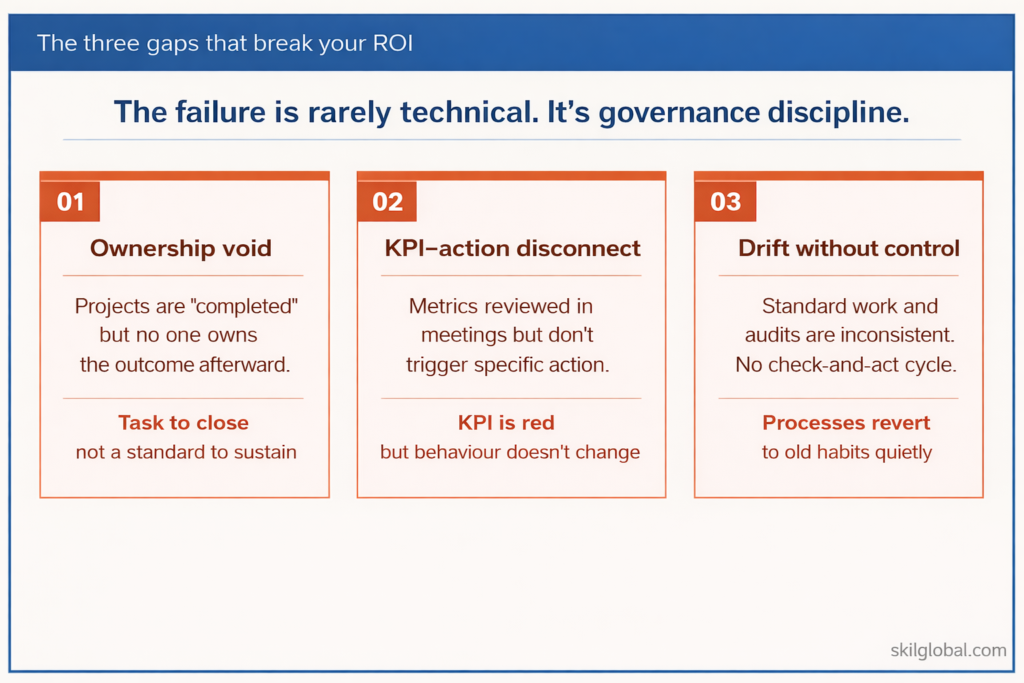
The Ownership Void
Projects are “completed,” but no one owns the outcome afterward.
Improvement becomes a task to close — not a standard to sustain.
The KPI-to-Action Disconnect
Metrics are reviewed in meetings, but don’t trigger specific actions.
If a KPI is red and behavior doesn’t change, the metric becomes noise.
The Drift Without Control
Standard work and audits are inconsistent.
Without a strong “check” and “act” cycle, processes revert to old habits.
Case Insight: Converting 75% Availability into Financial Impact
In a large FMCG brewery bottling plant, multiple past initiatives had improved performance — but none sustained.
- Line availability was stuck at ~75%
- Breakdowns kept recurring
- Teams were active, but results were inconsistent
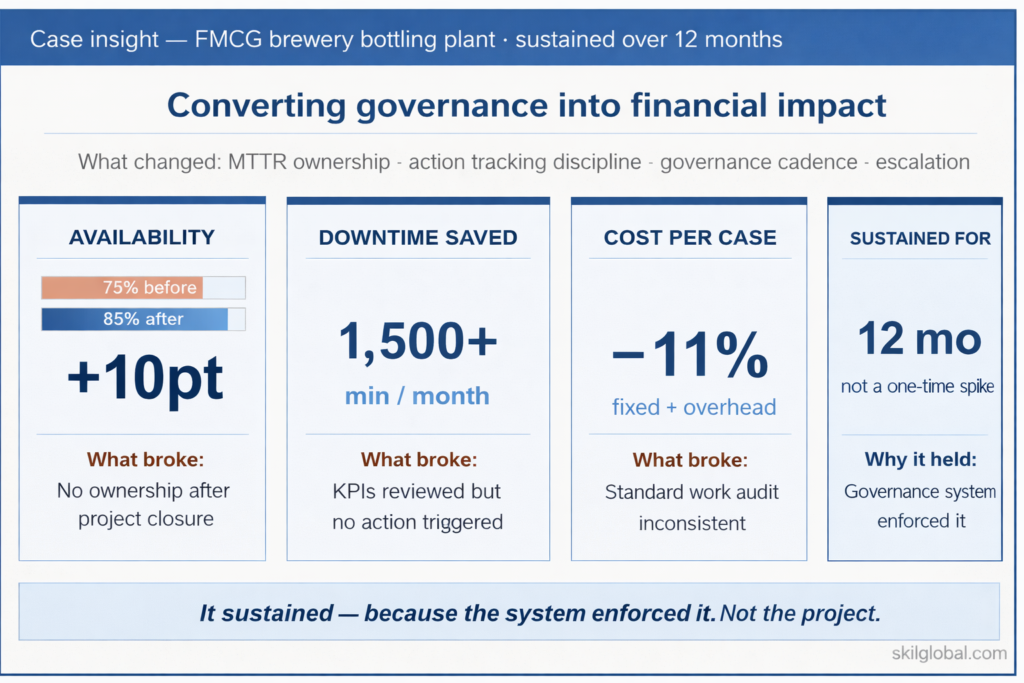
What Changed
Instead of adding more projects, the focus shifted to building governance systems:
- Structured MTTR reduction with clear ownership across teams
- Action tracking discipline, where closure required data validation
- Governance cadence with shift, daily, and weekly reviews
- Defined escalation triggers linked to KPI deviations
The Results (Sustained over 12 months)
- Availability improved from 75% → 85%
- Over 1,500 minutes of downtime eliminated per month
- 11% reduction in fixed and overhead cost per case
This was not a one-time improvement.
It sustained — because the system enforced it.
The Shift: From Project Completion to Performance Ownership
High-performing plants don’t just implement solutions.
They build systems that protect performance.
This requires a shift:
- From initiative-driven improvement
- To governance-driven performance
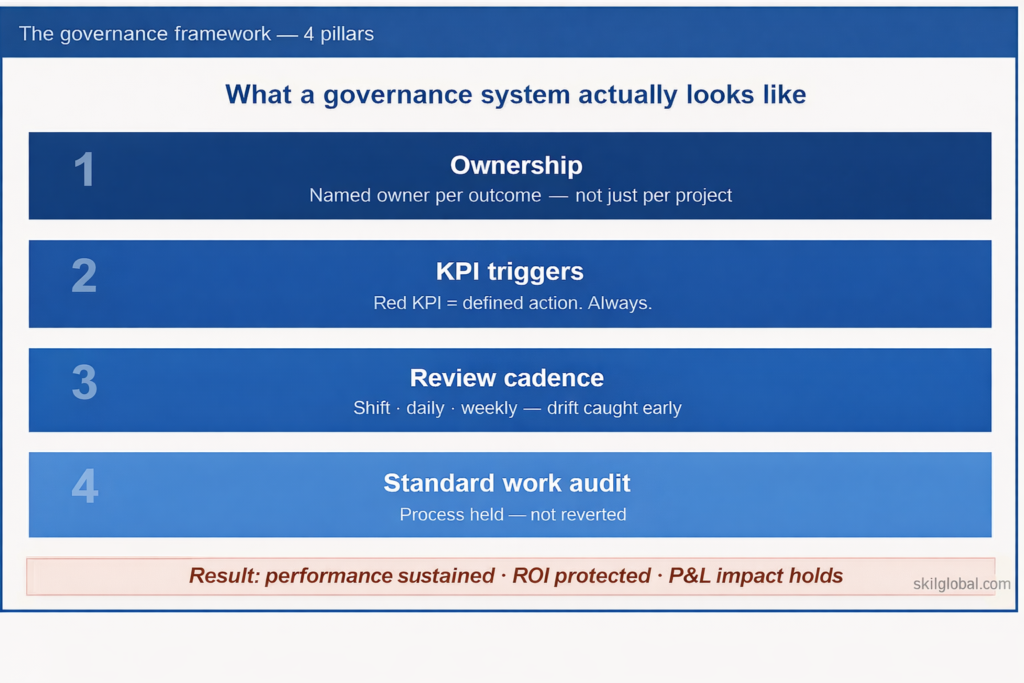
Build a System That Holds
If your initiatives feel effective but short-lived,
the issue isn’t capability — it’s your control framework.
Over time, this is not just operational drift —
it is direct P&L leakage from improvements that never sustain.
What You Can Do Next
1. Build Your Governance Framework (Free Download)
If your plant struggles to convert improvement opportunities into visible shopfloor results, it is likely an execution and governance gap. Use our practical 90-Day Playbook to bridge that gap with a disciplined framework.
A quick diagnostic for you: When you look at your past improvement projects, what percentage of them still have active, updated standard work and regular audits in place? (If your answer is “not many,” you might be facing an execution risk.)
2. Turn Governance into Results
If you want to apply this in your plant with a structured program:
👉 Book a 45-Minute Improvement Scoping Call